
Time for Your Home's Annual Checkup
December is a funny month in Palm Beach County. The weather finally cools off (sort of), the holiday parties are in full swing, and there's this feeling of wrapping things up before the new year. It's the perfect time to give your home's exterior an honest, thorough assessment.
Think of this as your home's annual physical. You're not necessarily fixing everything today -- you're identifying what needs attention, prioritizing it, and creating a plan for the year ahead. Some things you'll want to handle before the new year. Others go on the January-to-March list. And a few might be "keep an eye on this" items.
Grab your phone, a notepad, and about 45 minutes. We're going to walk every inch of your property's exterior.
The Full Perimeter Walkthrough
Start at your front door and work clockwise around the entire house. Don't rush this. The whole point is to look at things you normally walk past without noticing.
Roof Assessment (From Ground Level)
You don't need to get on your roof for this -- and frankly, you shouldn't. A ground-level assessment with binoculars or your phone's zoom tells you most of what you need to know.
Look for:- Algae streaking: Those dark streaks running down from the ridge line. Rate it on a 1-5 scale. Light streaking (1-2) means you're due for cleaning in the next few months. Heavy streaking (4-5) means you should schedule a soft wash soon.
- Moss or lichen: Green patches, especially on north-facing sections. This is more serious than algae because it has root systems that penetrate beneath shingles.
- Missing or damaged shingles/tiles: Look for gaps, lifted edges, cracked tiles, or areas where the color doesn't match (indicating replacement tiles from previous repairs).
- Flashing condition: Check around vents, chimneys, skylights, and where the roof meets walls. Rusted, bent, or separated flashing is a leak waiting to happen.
- Gutter condition (from below): Sagging sections, visible rust, gaps between joints, overflow staining on the fascia.
- Debris accumulation: Leaves, branches, and dirt in valleys and along edges. This traps moisture and accelerates deterioration.
- Good: Minor algae, no visible damage, gutters functional. Schedule cleaning in the next 3-6 months.
- Fair: Moderate algae, some debris buildup, minor gutter issues. Schedule cleaning within 1-3 months.
- Needs attention: Heavy algae/moss, visible damage, gutter problems. Schedule service as soon as possible.
Wall Condition Scoring
Walk each side of your home slowly, looking at the walls from foundation to roofline.
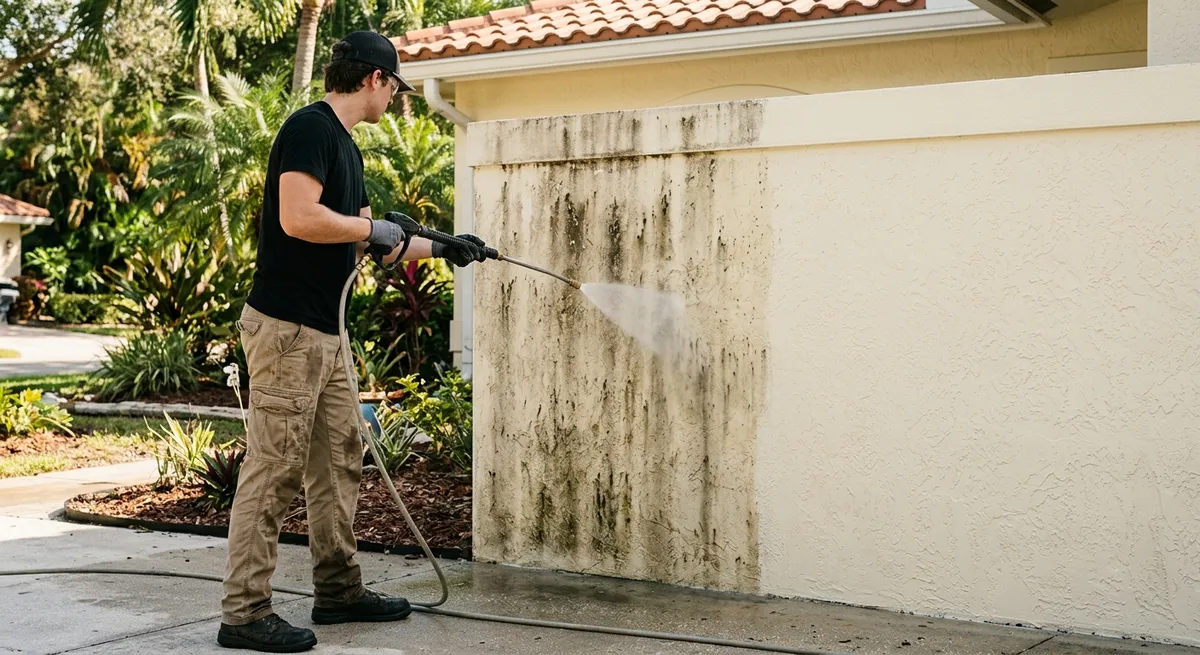
Check for:- Mold and mildew: The most common issue in South Florida. Dark spots, green tinge, or black patches. Particularly common on north-facing walls, near landscaping, and in areas that don't get much airflow.
- Algae creep: Green growth climbing up from ground level. Usually starts at the base and works its way up. This indicates moisture is being held against the wall, often by mulch or landscaping that's too close.
- Paint condition: Look for peeling, bubbling, chalking (white powder when you rub the surface), fading, or cracking. Note which areas are worst.
- Stucco cracks: Common in South Florida homes. Hairline cracks are usually cosmetic. Cracks wider than 1/8 inch, especially near windows and doors, could indicate structural movement.
- Caulking failures: Check around every window, door frame, and where different materials meet. Failed caulk means moisture intrusion.
- Efflorescence: White, chalky deposits on masonry surfaces. This indicates moisture moving through the wall and depositing minerals on the surface.
- Pest evidence: Wasp nests, mud dauber tubes, termite shelter tubes (the brown mud tunnels climbing up your foundation wall). Termite tubes are an emergency -- call a pest professional immediately.
Hardscape Evaluation
Now look down. Assess every hard surface on your property.
Driveway:- Overall cleanliness (1-5 scale)
- Algae or mold growth (location and severity)
- Staining (oil, rust, tannin, tire marks)
- Surface condition (cracks, pitting, spalling, settled areas)
- Joint condition (for pavers -- weeds, moss, sand loss)
- Drainage (does water flow away from the house or pool?)
- Same criteria as driveway
- Safety check: Are any areas slippery when wet? This is a liability issue, not just aesthetic.
- Trip hazards from settled or heaved sections
- Algae and mold (especially common given constant moisture)
- Surface texture (has it become too smooth/slippery from wear?)
- Crack or settlement patterns
- Drainage around the pool edge
- Coping condition
- Staining and general cleanliness
- Condition under outdoor furniture (move things around and look)
- Expansion joint condition
- Retaining walls
- Decorative curbing
- Stepping stones
- Outdoor kitchen or grill area surfaces
Screen Enclosure Check
If you have a screened pool enclosure or lanai -- and most Palm Beach County homes do -- give it a thorough inspection.
- Screen panels: Look for tears, holes, stretched areas, and panels separating from frames. Even small tears let in bugs and eventually get worse.
- Frame condition: Check for bent or bowed sections, rust spots (especially at joints and ground level), and loose fasteners.
- Door function: Do the doors close and latch properly? Rollers and tracks in good shape?
- Top panels: Look up. The top/roof panels often take the most weather abuse and may be sagging, torn, or stained.
- Cleanliness: Is the screen hazy with mold or pollen buildup? Dirty screens reduce airflow and light, making your patio less enjoyable.
Gutter and Drainage Review
Gutters protect your home from water damage, but they only work when they're clean and functional.
- Visual check: Look for sagging, pulling away from the fascia, rust, or visible debris buildup.
- Downspouts: Are they connected and directing water away from the foundation? Extensions should carry water at least 4-6 feet from the house.
- Overflow evidence: Look for staining on the fascia board below the gutter line or erosion below the gutter edge. These indicate chronic overflow from clogs.
- Drainage paths: Where does the water go after it leaves the downspouts? Is it pooling near the foundation? Running toward the neighbor's property?
Landscaping Buffer Zone
This is one of the most overlooked factors in exterior maintenance. The relationship between your landscaping and your house directly affects how fast mold and algae grow.
- Vegetation clearance: Nothing should be touching your house. Maintain a minimum 12-inch gap between plants and exterior walls. Touching plants trap moisture against the wall and provide a highway for pests.
- Mulch level: Mulch should be 2-3 inches deep, not 6+. Excessive mulch holds moisture against the foundation and can lead to termite and moisture problems. Keep mulch 6 inches away from the wall.
- Tree overhang: Note any branches hanging over the roof. These drop debris, shade the roof (promoting algae), and can cause damage in storms.
- Irrigation spray: Is your irrigation system spraying your walls, windows, or exterior fixtures? This is a major cause of hard water stains, mineral deposits, and accelerated mold growth.
Creating Your Maintenance Priority List for the New Year
Now that you've completed the walkthrough, it's time to organize what you found. Grab your notes and sort everything into three buckets:
Fix Now (Before January)
These are items that are actively causing damage or creating safety hazards:
- Termite evidence -- call a pest professional this week
- Active leaks or water intrusion from failed caulking or flashing
- Safety hazards -- slippery walkways, trip hazards, loose railings
- Severe gutter clogs or damage (rainy season may be over, but you still get storms)
- Vegetation touching the house -- takes 30 minutes to trim back
- Irrigation hitting the house -- adjust sprinkler heads today
Schedule for Q1 (January-March)
These items need attention but can be planned and budgeted:
- Roof cleaning (if scored "fair" or worse)
- House washing (if mold and mildew are moderate to heavy)
- Driveway and hardscape cleaning (if staining and growth are significant)
- Screen repair or rescreening
- Paint touch-ups or repainting (dry season is the best time)
- Caulking replacement around windows and doors
- Gutter cleaning and repair
Monitor Through 2025
These items aren't urgent but need watching:
- Minor stucco cracks -- photograph them and check again in 6 months. If they're growing, address them.
- Early-stage surface deterioration on hardscapes -- not replacement-level yet but heading that direction.
- Roof granule loss -- check gutters after the next heavy rain. Increasing granule loss means the roof is aging.
- Fading or chalking paint -- still functional but planning for repaint within 1-2 years.
Budget Planning for Next Year
Based on your walkthrough, here's a framework for budgeting exterior maintenance in Palm Beach County:
Annual Maintenance Budget (Typical Home)
The "Fix It Now vs. Wait" Decision Framework
For each item on your list, ask these three questions:
1. Is it getting worse? If yes, fix it now. Exterior problems in South Florida compound rapidly. What costs $200 to fix today might cost $2,000 in a year.
2. Is it causing secondary damage? A clogged gutter doesn't just need cleaning -- it's causing fascia rot, foundation erosion, and wall staining. Fix the root cause before the secondary damage multiplies the cost.
3. Is it affecting your home's value or your enjoyment of the property? Sometimes the answer is "it's ugly but stable." Those items can wait for scheduled maintenance. But if it's impacting your daily experience or your home's market position, bump it up the priority list.
Starting the New Year Clean
There's something genuinely satisfying about starting a new year with a clean, well-maintained home. Not because of some Instagram-perfect ideal, but because your home is your biggest investment, your daily environment, and your family's shelter. Taking care of it just makes sense.
The December walkthrough isn't about finding problems to stress over. It's about taking control. When you know exactly what your home needs, you can plan, budget, and act strategically instead of reacting to emergencies and surprise repair bills.
And honestly? Most of what you'll find is manageable. A good cleaning, some minor repairs, and a maintenance schedule -- that's all most Palm Beach County homes need to stay in great shape year after year.
Get your free quote from Crouching Tiger Exterior Cleaning and start the new year with a clean slate -- literally. We'll help you prioritize what needs attention and put together a maintenance plan that keeps your home looking great all year long. Serving Palm Beach Gardens, Jupiter, West Palm Beach, and all of Palm Beach County.