Something Is Growing on Your House — But What?
Living in South Florida means living with organic growth. It's inevitable. Our combination of heat, humidity, frequent rain, and subtropical vegetation creates a paradise for all kinds of organisms that love to colonize the exterior of your home.
But here's the thing — not all growth is the same. The black streaks on your roof are a completely different organism than the green film on your fence. The white crust on your pavers is nothing like the fuzzy patches on your north-facing wall. And each type requires a different approach to remove it safely and effectively.
Knowing what you're looking at helps you understand how serious the problem is, whether you can handle it yourself or need professional help, and what kind of treatment will actually work. So let's break it down.
1. Black Algae (Gloeocapsa Magma)
What It Looks Like
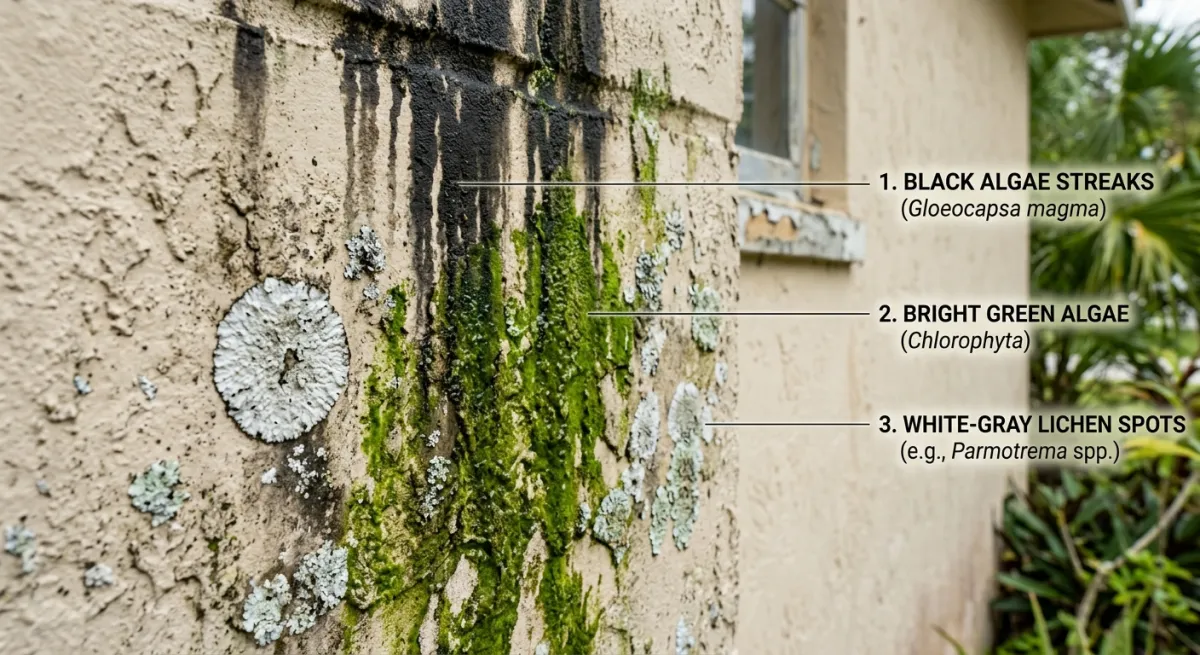
Dark black or dark gray-green streaks, usually running vertically down surfaces. On roofs, it typically starts near the ridge line and spreads downward in streaking patterns that follow rainwater flow. On walls, it appears as dark patches or streaks beneath windows, gutters, and rooflines where water drips.
The color comes from the algae's dark protective outer coating — a melanin-like pigment that shields the organism from UV radiation. Early-stage Gloeocapsa Magma actually appears as light green spots, but by the time most homeowners notice it, the dark streaking is well established.
Where It Grows
Gloeocapsa Magma is the single most common exterior growth in South Florida. You'll find it on:
- Asphalt shingle roofs — this is its favorite surface because it feeds on the limestone filler in shingles
- Tile roofs — particularly in the textured surfaces between and on tile
- Stucco and painted exterior walls
- Concrete surfaces that stay damp
How Fast It Spreads
Gloeocapsa Magma is a slow burn. It can take months or even a year before the dark streaking becomes obvious to the naked eye. But once you can see it, the colony is well established and spreading steadily. It propagates through airborne spores, which means it can spread from roof to roof across a neighborhood.
Does It Cause Damage?
Yes. On roofs, it feeds on limestone in shingles and accelerates granule loss, which shortens your roof's lifespan. It also darkens the surface, which absorbs more heat and increases cooling costs. On walls and other surfaces, it creates a biofilm layer that retains moisture against the surface, which can accelerate paint deterioration and stucco breakdown over time.DIY or Professional?
Professional. Gloeocapsa Magma is deeply established by the time it's visible. Surface scrubbing won't eliminate it — you need a proper soft wash treatment with sodium hypochlorite to kill it at the root. On roofs, attempting DIY removal risks serious damage to your shingles and personal injury from working at height.2. Green Algae
What It Looks Like
Bright green to dark green film or patches on surfaces. It looks slimy when wet and can appear powdery when dry. Green algae is the growth most people think of when they picture a "dirty" fence or walkway — that green coating that makes everything look neglected.
Where It Grows
Green algae is the most adaptable growth in our climate. It thrives on:
- Vinyl fences — extremely common, turns white fences green within months
- Concrete driveways and walkways
- Pool decks and pavers
- Wood surfaces
- Virtually any horizontal or north-facing surface that stays damp
How Fast It Spreads
Fast. Green algae is the fastest-growing exterior organism in South Florida. A surface can go from clean to noticeably green in as little as 4-8 weeks during the rainy season (June through October). It slows down somewhat in the drier winter months but never fully stops in our climate.
Does It Cause Damage?
Moderate. Green algae itself doesn't aggressively attack surfaces the way Gloeocapsa Magma attacks shingles. But it does create a persistently moist layer on surfaces, which contributes to the degradation of paint, sealants, and wood. On walkways and pool decks, it's a significant slip hazard — green algae on wet concrete is dangerously slippery.DIY or Professional?
Both, depending on the surface. Light green algae on a vinyl fence or concrete walkway can sometimes be managed with a garden hose sprayer attachment and an exterior cleaning product from the hardware store. However, professional cleaning is significantly more effective and longer-lasting because we treat the surface with solutions that kill the algae's root structure, not just the visible growth.3. Mold
What It Looks Like
Dark black, dark green, or dark brown patches that look fuzzy or three-dimensional up close. Mold grows in irregular, splotchy patterns rather than the uniform coating you see with algae. It often appears concentrated in specific spots rather than spread across an entire surface.
Where It Grows
Mold thrives in areas with persistent moisture and limited airflow:
- Under eaves and soffits where trapped moisture can't dry
- Around HVAC units and dryer vents where condensation is constant
- In corners and crevices where air doesn't circulate
- On north-facing walls, especially behind dense landscaping
- Inside screen enclosures where airflow is restricted
How Fast It Spreads
Moderate. Mold grows steadily in ideal conditions but isn't as visually aggressive as green algae. However, mold produces spores continuously, and once established, it seeds the surrounding area. A single mold colony under your eave can spread spores to your walls, roof, and nearby surfaces.
Does It Cause Damage?
Yes, and it can be serious. Mold actively breaks down organic materials. On wood soffits, fascia, and trim, mold causes rot. On painted surfaces, it gets beneath the paint film and causes peeling and bubbling. Beyond property damage, certain molds produce mycotoxins that are harmful to breathe. Exterior mold near windows, doors, or HVAC intakes can affect indoor air quality.DIY or Professional?
Professional for established mold. Small spots can be treated with appropriate fungicidal cleaners, but widespread mold needs professional treatment — both for effectiveness and because it may indicate an underlying moisture problem that should be identified. If mold keeps returning to the same spot after cleaning, something is feeding it moisture.4. Mildew
What It Looks Like
Mildew appears as flat, powdery patches that are white, gray, or light brown in early stages. It often develops in thin, spreading patterns across surfaces. Many homeowners confuse mildew with dust or general dinginess. A simple test: dab a drop of household bleach on the spot. If it lightens within a minute or two, it's mildew.
Where It Grows
Mildew is essentially surface-level fungal growth. It favors:
- Exterior painted surfaces, especially in humid, sheltered areas
- Vinyl siding and vinyl fences
- Under roof overhangs and covered patios
- On patio furniture, cushions, and outdoor fabrics
How Fast It Spreads
Moderate to fast, depending on humidity. During the rainy season, mildew can spread across a wall in weeks. It slows considerably during drier periods.
Does It Cause Damage?
Mild. Mildew is the least damaging of the organisms on this list. It's primarily a cosmetic issue on most exterior surfaces. However, if left unchecked for extended periods, it can contribute to paint deterioration and create conditions favorable for actual mold to establish.DIY or Professional?
DIY for small areas, professional for large areas. A solution of one part bleach to three parts water, applied with a pump sprayer and rinsed after 10 minutes, handles mildew effectively on most surfaces. For whole-house mildew, professional soft washing is more practical and ensures complete coverage.5. Lichen
What It Looks Like
Lichen is a composite organism — it's actually a partnership between algae and fungus. It appears as flat, crusty, circular patches that can be green-gray, yellow-green, orange, or even white. Lichen has a distinctive "crusty" texture and adheres very tightly to surfaces. It almost looks like it's part of the surface itself.
Where It Grows
Lichen is slower-growing than algae or mold and prefers stable, undisturbed surfaces:
- Tile and concrete roofs — very common on barrel tile roofs throughout Palm Beach County
- Concrete pavers and natural stone
- Tree trunks (not harmful to the tree, just using it as a surface)
- Metal surfaces including aluminum fences and outdoor fixtures
How Fast It Spreads
Slow. Lichen is the slowest-growing organism on this list. It takes months to years to form visible patches. If you're seeing lichen, it means the surface has been undisturbed and unclean for a significant period.
Does It Cause Damage?
Yes, particularly on roofs. Lichen attaches to surfaces using root-like structures called rhizines that actually penetrate the surface material. On roof tiles, lichen slowly breaks down the surface and can lift small pieces of tile material when removed. On pavers and stone, it causes pitting over very long periods. The damage is real but slow.DIY or Professional?
Professional. Lichen's strong attachment to surfaces makes it the most difficult growth to remove. Scrubbing or pressure washing alone won't kill the embedded rhizines — the lichen will regrow from what's left behind. A professional soft wash treatment kills the entire organism, including the root structure. Dead lichen then gradually releases from the surface over the following weeks as rain washes it away.6. Moss
What It Looks Like
Thick, green, carpet-like growth. Moss is the most three-dimensional growth you'll encounter — it forms a visible raised layer on surfaces. It's soft and spongy when wet, and crispy and brown when very dry (but it revives when moisture returns).
Where It Grows
Moss needs consistent shade and moisture, so it's less common on South Florida homes than in more temperate climates. But you'll find it:
- On north-facing roof sections heavily shaded by trees
- Between pavers and in expansion joints of concrete
- On the base of walls in deeply shaded, moist areas
- On decorative stone and rock features in landscaping
How Fast It Spreads
Moderate in ideal conditions, very slow in direct sun (where it won't survive at all). Moss needs shade and consistent moisture to establish. Once it has both, it spreads steadily.
Does It Cause Damage?
Yes. On roofs, moss retains water like a sponge, keeping the surface perpetually moist. This leads to rot on wood components and can work under shingles or tiles, causing leaks. Between pavers, moss pushes joints apart over time and can displace leveling sand. It also creates significant slip hazards on walkways and pool decks.DIY or Professional?
Professional for roofs, either for ground-level surfaces. Moss on pavers and walkways can be manually removed and treated with a moss killer from the hardware store. Roof moss should always be handled by professionals — removing it improperly can damage shingles and tiles, and working on a moss-covered roof is extremely dangerous due to how slippery it is.The Decision Tree: What Am I Looking At?
Use this quick guide to identify what's growing on your surfaces:
I see BLACK streaks or patches:- On roof, flowing downward in streaks → Gloeocapsa Magma (black algae)
- On walls/concrete, splotchy and irregular → Mold
- Flat and powdery, comes off easily → Mildew
- Slimy film or coating across the surface → Green algae
- Thick, carpet-like, raised from surface → Moss
- Flat, crusty circles tightly attached → Lichen
- Powdery, flat, wipes off with a finger → Mildew
- Crusty, circular, firmly attached → Lichen
- Chalky white deposits (not organic) → Efflorescence (mineral deposits — different issue entirely)
- Firmly attached, circular pattern → Lichen
When Growth Indicates a Bigger Problem
Most exterior growth is simply a consequence of living in South Florida's climate. But sometimes, concentrated or recurring growth in a specific area indicates an underlying moisture issue:
- Mold that keeps returning to the same wall area may indicate a plumbing leak behind the wall, failed caulking around a window, or an HVAC condensation issue
- Excessive growth near the base of walls often points to grading problems — water is pooling against your foundation instead of draining away
- Growth concentrated around soffits or roofline may indicate poor attic ventilation trapping moisture
- One side of the house dramatically worse than the other is usually normal (north-facing vs. south-facing) but occasionally indicates a failed gutter or irrigation head spraying the wall
Keep It Clean, Keep It Protected
Now that you know what you're looking at, the next step is getting it taken care of. Every type of growth on this list is treatable, and the sooner you address it, the less damage it does and the easier it is to remove.
For homes in Palm Beach Gardens, Jupiter, West Palm Beach, and throughout Palm Beach County, we deal with all six of these organisms daily. We adjust our cleaning chemistry and methods based on exactly what's growing and what surface it's growing on.
Get your free quote and tell us what you're seeing — we'll identify it, explain the best treatment, and get your home back to looking the way it should. No guesswork, no damage, just results.