Florida's Beautiful Trees Have an Ugly Secret
We love our trees in South Florida. Live oaks draped with Spanish moss. Royal palms lining the boulevards. Massive ficus trees providing shade from the relentless sun. These trees are a huge part of what makes Palm Beach Gardens, Jupiter, and the surrounding areas so beautiful.
But if you've lived here for more than a season, you know the other side of the story. Those gorgeous trees are constantly dropping things onto your driveway, walkways, pool deck, and house walls. And the stains they leave behind are some of the most stubborn, frustrating marks you'll ever deal with on exterior surfaces.
This isn't a problem unique to Florida, but it's dramatically worse here because of the species of trees we have, the volume of organic material they produce, and the year-round growing conditions that keep them actively shedding.
The Stain Types: What's Actually on Your Concrete
Not all tree stains are the same, and they don't all respond to the same treatment. Understanding what you're dealing with is the first step to getting rid of it.
Tannin Stains (The Big One)
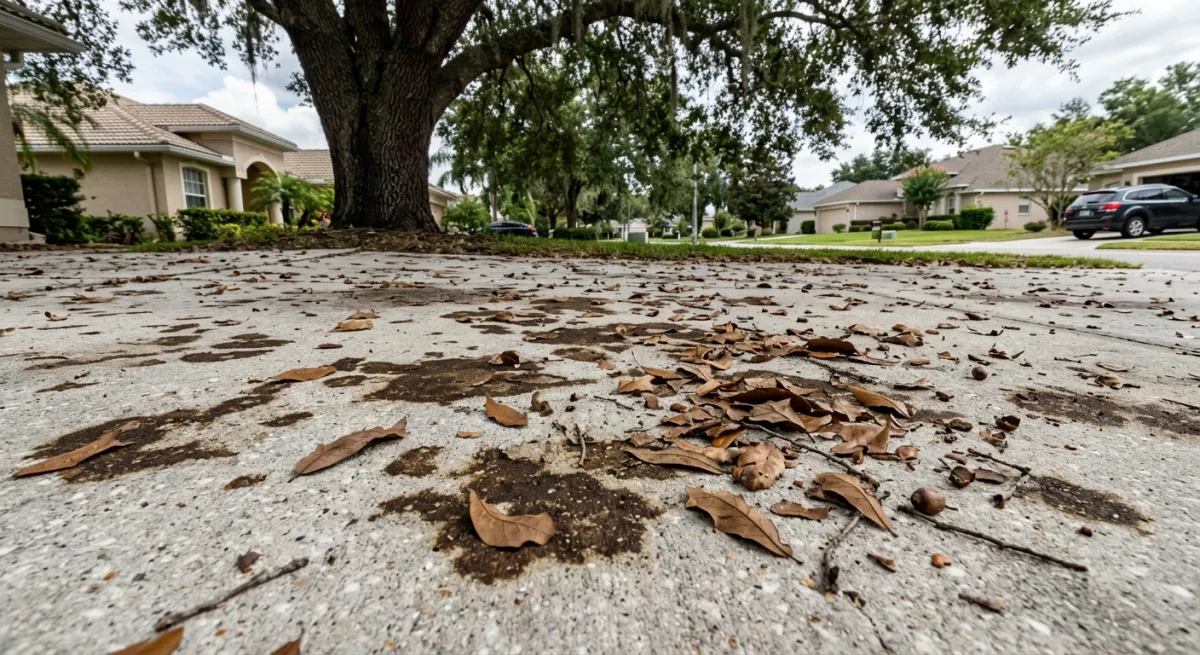
Tannins are naturally occurring organic compounds found in bark, leaves, and wood. When leaves sit on a wet surface -- like your driveway after a rain shower -- tannins leach out and soak into the concrete or pavers below.
What they look like: Dark brown, reddish-brown, or orange stains, often in the shape of individual leaves or in broad patches where leaves accumulated. They range from light tea-colored marks to deep, almost black staining. The Florida connection: Our live oaks are prolific tannin producers. When live oaks drop their leaves in spring (yes, they're technically "evergreen" but they still shed), the volume of leaf litter is enormous. Those leaves sit on your driveway, get rained on repeatedly, and bleed tannins into the surface over days and weeks.But it's not just oaks. Magnolias, cypress trees, and pine straw all produce significant tannin staining. In neighborhoods throughout Palm Beach County, it's nearly impossible to avoid tannin exposure on your hardscape.
Sap Drips
Tree sap is the sticky, often clear or amber substance that drips from branches, particularly from pine trees, ficus, and certain palm species.
What they look like: Shiny, sticky spots that darken over time. They attract dirt and debris, creating dark, hard-to-remove patches. On concrete, old sap stains look like small dark circles or drip patterns. Why they're tough: Sap is essentially a natural resin. Once it hardens, it bonds to surfaces at a molecular level. Water alone won't touch it. Even pressure washing often just removes the surface layer while leaving the stain embedded in the pores of the concrete.Fruit and Berry Drops
South Florida is full of fruit-bearing trees, and many of them drop fruit directly onto hardscaped surfaces.
The worst offenders:- Black olive trees -- These are everywhere in South Florida landscaping, and their small dark fruits create deep purple-black stains that are among the hardest to remove. If you have a black olive tree near your driveway, you know exactly what we're talking about.
- Ficus fruit -- Small but prolific, ficus fruit gets crushed underfoot and ground into surfaces.
- Palm berries -- Particularly from queen palms and coconut palms, the fruit drops create orange and brown staining.
- Mango and avocado -- Larger fruit that splits on impact and leaves concentrated stains.
Pollen and Catkin Residue
During spring, oak trees release massive amounts of pollen and catkins (those yellow-green fuzzy things). While pollen itself is relatively easy to wash away, catkins contain tannins and leave stains when they decompose on surfaces.
What they look like: Yellowish-green staining that darkens to brown over time, often widespread rather than in discrete spots.Why These Stains Won't Wash Away with Water Alone
Here's the frustrating reality: you can spray your driveway with a garden hose all day long and these stains won't budge. Even pressure washing with plain water often disappoints. Here's why:
Tannins are water-soluble -- which is actually the problem. They dissolve in water and then get carried deep into the pores of concrete and pavers. Each rain event drives them deeper. By the time you notice the stain, the tannin has penetrated well below the surface. Sap is hydrophobic. It repels water, so water-based cleaning just rolls right off the hardened resin. Fruit stains contain natural pigments (anthocyanins, carotenoids) that chemically bond with mineral surfaces like concrete. The alkaline nature of concrete actually helps set these pigments, similar to how a mordant sets dye in fabric. Concrete and pavers are porous. Unlike a sealed kitchen countertop, exterior concrete has microscopic pores and capillaries that absorb liquids. Staining materials wick into these pores and become part of the surface. Surface-level cleaning doesn't reach them.Chemical Treatments That Actually Work
Different stain types require different chemical approaches. Here's what we use and why:
For Tannin Stains
Oxalic acid is the gold standard for tannin removal. It works by chemically reacting with the tannin compounds and breaking them down into colorless, water-soluble byproducts that can be rinsed away.We apply oxalic acid-based solutions directly to tannin stains, allow dwell time for the chemical reaction, and then rinse with appropriate pressure. For severe staining, multiple applications may be needed because tannins often exist in layers within the concrete pores.
Sodium hydroxide (in controlled concentrations) can also be effective, particularly for older, set-in tannin stains. However, this must be used carefully on concrete -- too strong a solution or too long a dwell time can etch the surface.For Sap Stains
Sap requires a solvent-based approach because water-based cleaners can't dissolve the resin. We use specialized degreasing agents that break down the sap's molecular bonds with the surface.
For fresh sap, the process is relatively straightforward. For old, hardened sap that's been baking in the South Florida sun for months, it takes more aggressive treatment and sometimes mechanical agitation with surface cleaning equipment.
For Fruit and Berry Stains
These respond best to alkaline cleaners combined with hydrogen peroxide-based brighteners. The alkaline cleaner breaks down the organic material, while the peroxide bleaches the remaining pigment without damaging the concrete.
Black olive stains are the exception -- they're notoriously resistant and often require multiple treatment rounds with varying chemistry. We won't sugarcoat it: some old black olive stains may lighten significantly but not disappear completely if they've been ground in for years.
For General Organic Staining
A good sodium hypochlorite soft wash handles the biological component -- killing mold, algae, and bacteria that are often mixed in with tree staining. This is typically our first step before targeting specific stain types with specialized chemistry.
Prevention Strategies
Removing stains is important, but preventing them from forming in the first place saves you time, money, and frustration.
Regular Leaf Removal
This is the single most effective prevention measure. Don't let leaves sit on your hardscape. In palm Beach Gardens neighborhoods with heavy oak coverage, this might mean blowing the driveway twice a week during leaf drop season (typically February through April for live oaks).
Yes, it's tedious. But a leaf that gets blown off before the next rain can't stain your concrete.
Tree Trimming
Keeping branches trimmed back from directly above driveways, walkways, and patios reduces the volume of debris that lands on these surfaces. This is especially important for:
- Black olive trees -- Trim aggressively to keep fruit away from hardscape
- Ficus -- These grow fast and need regular trimming to prevent spread over driveways
- Oaks -- Raise the canopy to reduce leaf drop density on surfaces below
Concrete Sealing
A quality concrete sealer creates a barrier that prevents staining materials from penetrating into the pores. Sealed concrete is dramatically easier to clean because stains sit on top of the sealer rather than soaking in.
We recommend sealing driveways and walkways after professional cleaning, then resealing every 2-3 years depending on traffic and sun exposure. It's one of the best investments you can make for long-term surface protection.
Strategic Landscaping
If you're planning new landscaping or replacing trees, consider the staining potential:
Trees with lower staining risk:- Sabal palms (Florida's state tree -- minimal fruit drop)
- Bald cypress (moderate tannins but manageable)
- Crape myrtle (minimal drip issues)
- Black olive (the worst offender in South Florida)
- Live oak (beautiful but prolific tannin producers)
- Ficus (aggressive growers with messy fruit)
- Mango (heavy fruit drop with deep staining)
The Seasonal Cycle of Staining in Florida
Understanding when staining is worst helps you plan your cleaning schedule:
February - April: Live oak leaf drop. This is prime tannin season. Massive volumes of leaves shed and accumulate on surfaces. If you're going to schedule one cleaning per year, doing it in late April after the oaks finish dropping makes sense. May - October: Rainy season. Afternoon thunderstorms drive tannins deeper into surfaces and create standing water conditions that amplify staining. Fruit drops from palms, mangos, and ficus peak during summer months. September - November: Black olive fruiting season. If you have black olive trees, this is when staining gets worst. November - January: The driest months. Less active staining, and the best window for cleaning and sealing since surfaces dry thoroughly and sealers cure properly in lower humidity.When to Call a Professional
Some light tannin staining from a few leaves can be handled with over-the-counter oxalic acid cleaner and some elbow grease. But call a professional when:
- Stains cover large areas of your driveway or walkways
- You've tried DIY cleaning without success
- Black olive or ficus staining is involved (these need specialized treatment)
- Stains have been setting for more than a few weeks
- You want to clean AND seal in the same service visit
Get Your Surfaces Clean Again
Tree stains are one of the most common reasons homeowners in Palm Beach Gardens, Jupiter, and West Palm Beach call us. We deal with tannin stains, sap, fruit stains, and every other type of organic staining that Florida trees produce. Our multi-step cleaning process uses the right chemistry for each stain type, and we can follow up with sealing to prevent future staining.
Stop living with those ugly brown and black marks on your driveway. Get a free quote and let us show you what your hardscape is supposed to look like.