That Yellow-Green Film on Everything? It's Not Your Imagination
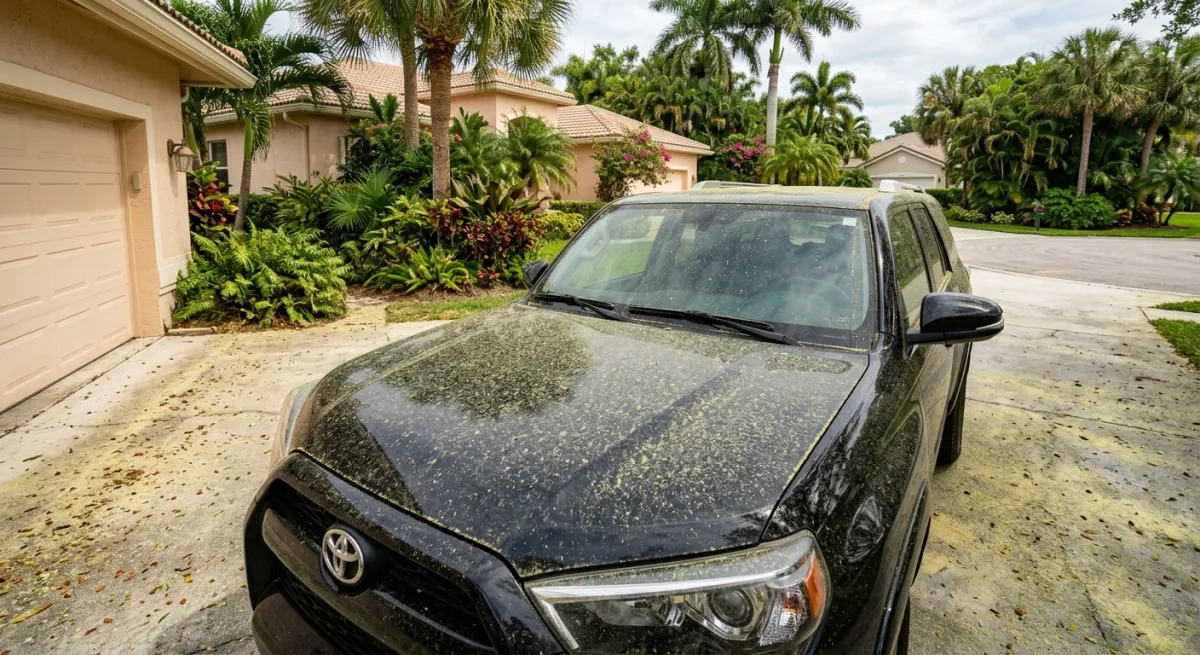
If you've stepped outside your Palm Beach Gardens home sometime between February and May, you already know: pollen season in South Florida is no joke. That fine yellow-green dust coating your car, your driveway, your patio furniture, your pool deck — it's everywhere. You wash your car on Saturday and by Monday it looks like it hasn't been touched in weeks.
Most people treat pollen as a minor annoyance. Something you rinse off the windshield and move on. But when it comes to your home's exterior surfaces, pollen is doing more than making things look dusty. It's setting the stage for real damage — especially in our humid, rainy climate.
Let's break down what's actually happening, which trees are the biggest offenders here in Palm Beach County, and what you should do about it before rainy season starts.
When Does Pollen Season Hit South Florida?
South Florida's pollen season runs from roughly February through May, with peak levels typically in March and April. Unlike northern states where pollen season is a concentrated few weeks in spring, ours is a slow build that can drag on for months.
The timing varies slightly each year depending on rainfall and temperatures, but here's the general pattern:
- February: Early tree pollens start, mostly oaks beginning to release
- March: Peak oak pollen — this is when you'll see the heaviest yellow coating on everything
- April: Oak pollen continues, pine pollen joins the mix, grass pollens start ramping up
- May: Tree pollen tapers off, grass pollen dominates through the transition into rainy season
The Biggest Pollen Producers in Palm Beach County
Not all trees contribute equally. Here are the main offenders you're dealing with around Palm Beach Gardens, Jupiter, and West Palm Beach:
Live Oaks
Live oaks are the single biggest pollen producers in our area. If you have a live oak on your property — or your neighbor does — you know exactly what we're talking about. In March and early April, they drop an almost unbelievable amount of pollen along with those stringy catkins that pile up in every corner. One large live oak can produce billions of pollen grains in a single season.
Slash Pines and Sand Pines
Pines are the second major contributor. Pine pollen is heavier and more visible than oak pollen — it produces that dramatic yellow cloud you sometimes see drifting on breezy days. Pine pollen tends to settle on horizontal surfaces like driveways, walkways, and pool decks. If you live near the pine scrub areas west of Palm Beach Gardens or in Jupiter Farms, pine pollen is a significant factor.
Sabal Palms and Other Palms
People don't think of palms as heavy pollinators, but they absolutely are. Sabal palms, coconut palms, and queen palms all produce significant amounts of pollen. Palm pollen is finer and lighter, which means it travels further and gets into more places — including crevices in your stucco, gaps in your screen enclosures, and the textured surfaces of pavers.
Brazilian Pepper (Florida Holly)
Brazilian pepper is technically an invasive species, but it's everywhere in South Florida. It flowers heavily and produces a fine, sticky pollen that clings to surfaces more aggressively than tree pollens. If you have Brazilian pepper near your property, you'll notice a slightly different quality to the buildup — stickier, harder to rinse off.
Grasses
By April and May, grass pollen joins the mix. Bahia grass, Bermuda grass, and St. Augustine grass — all common in South Florida lawns — release significant pollen. This overlaps with the tail end of tree pollen season, creating a one-two punch.
Why Pollen Is More Than a Cosmetic Problem
Here's where most homeowners underestimate what's happening. Pollen isn't just making your home look dirty. It's actively creating conditions for worse problems.
Pollen Traps Moisture
Pollen is organic material. When it accumulates on your roof, driveway, pavers, or stucco walls, it creates a thin layer that holds moisture against the surface. In South Florida's humidity, that moisture doesn't evaporate quickly. You've essentially created a damp blanket over your exterior surfaces.
This is exactly the environment that algae, mold, and mildew need to establish and spread. Pollen accumulation in March and April frequently leads to noticeable mold and algae growth by June and July — not because the rainy season caused it, but because pollen laid the groundwork weeks earlier.
Pollen Feeds Mold and Algae
Pollen isn't just trapping moisture — it's also food. Mold spores and algae cells use organic material as a nutrient source. A layer of pollen on your roof tiles, concrete driveway, or stucco walls is essentially a buffet for these organisms. This is why homes that aren't cleaned after pollen season tend to develop much heavier organic growth during the summer months than homes that are cleaned in late April or May.
The "Pollen Paste" Problem in Gutters
This one deserves special attention. When pollen combines with the other debris that collects in gutters — leaves, twigs, pine needles, seed pods — it creates what we call pollen paste. It's a thick, sticky sludge that doesn't rinse away easily and blocks water flow.
In Palm Beach County, this is particularly problematic because:
1. Clogged gutters during rainy season means water overflows against your fascia and foundation 2. Pollen paste holds moisture against aluminum gutters, accelerating corrosion 3. The organic mix decomposes, creating a rich soil-like substrate where weeds and seedlings can actually root inside your gutters 4. Blocked downspouts can cause water to pool on flat roofs or back up under roof tiles
We regularly clean gutters in April and May that are packed solid with pollen paste. Homeowners who had clean gutters in January are often shocked at how much accumulation happens in just a few months of pollen season.
The Allergy Connection You Haven't Considered
Here's something most people don't think about: pollen on your home's exterior surfaces affects your indoor air quality.
Every time you open a door, pollen that's accumulated on your entry walkway, front porch, and doorframe gets disturbed and enters your home. Pollen on screen enclosures gets pushed through by wind and deposited inside your lanai and patio areas. Pollen near your HVAC return intake gets pulled into your air system — even with decent filters, some of it gets through.
For the roughly 30% of adults and 40% of children who have allergic rhinitis (hay fever), this matters. If someone in your household has spring allergies and you haven't cleaned your home's exterior, they're getting constant low-level exposure that extends pollen season indoors well after outdoor levels drop.
Cleaning pollen off your exterior surfaces isn't just maintenance — it's a health consideration.When Is the Best Time to Clean?
Timing matters here. Clean too early and you're just going to get coated again. Clean too late and pollen has already done its damage.
The Sweet Spot: Late April Through Mid-May
The ideal window for post-pollen cleaning in Palm Beach County is late April through mid-May. Here's why:
- Peak oak pollen has passed (late March/early April)
- Pine pollen is winding down (mid-April)
- Before daily rain starts (late May/early June)
- Pollen hasn't been sitting long enough to cause significant secondary growth
What About Cleaning During Pollen Season?
If your home is particularly bad — heavy oak coverage, pooling pollen on flat surfaces, visible mold starting — it can be worth cleaning in mid-March and then again in May. Two lighter cleanings during and after pollen season can be more effective than one heavy cleaning later.
For most homes, though, one thorough cleaning in that late April to mid-May window is sufficient and cost-effective.
How Pressure Washing Removes Pollen Effectively
A garden hose can rinse loose pollen off your car, but it's not going to cut it for your home's exterior surfaces. Here's why professional pressure washing is the right approach:
Surface Texture Matters
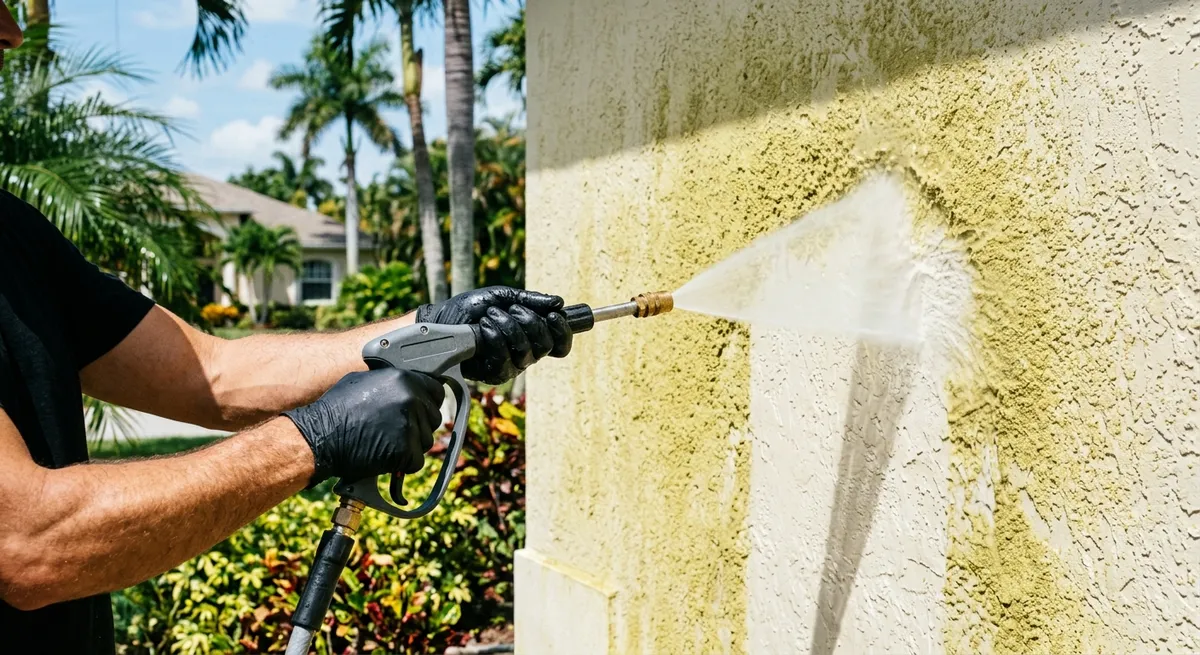
Your driveway concrete, roof tiles, stucco walls, and pavers all have textured surfaces. Pollen settles into those textures and bonds with moisture. A garden hose doesn't have the pressure to flush pollen out of the pores of concrete or the texture of stucco. Professional pressure washing at the appropriate PSI for each surface does.
Cleaning Solutions Break the Bond
We don't just blast water at surfaces. For post-pollen cleaning, we use biodegradable cleaning solutions that break down the organic bond between pollen and the surface. This is especially important for:
- Pollen paste in gutters — needs chemical action, not just water pressure
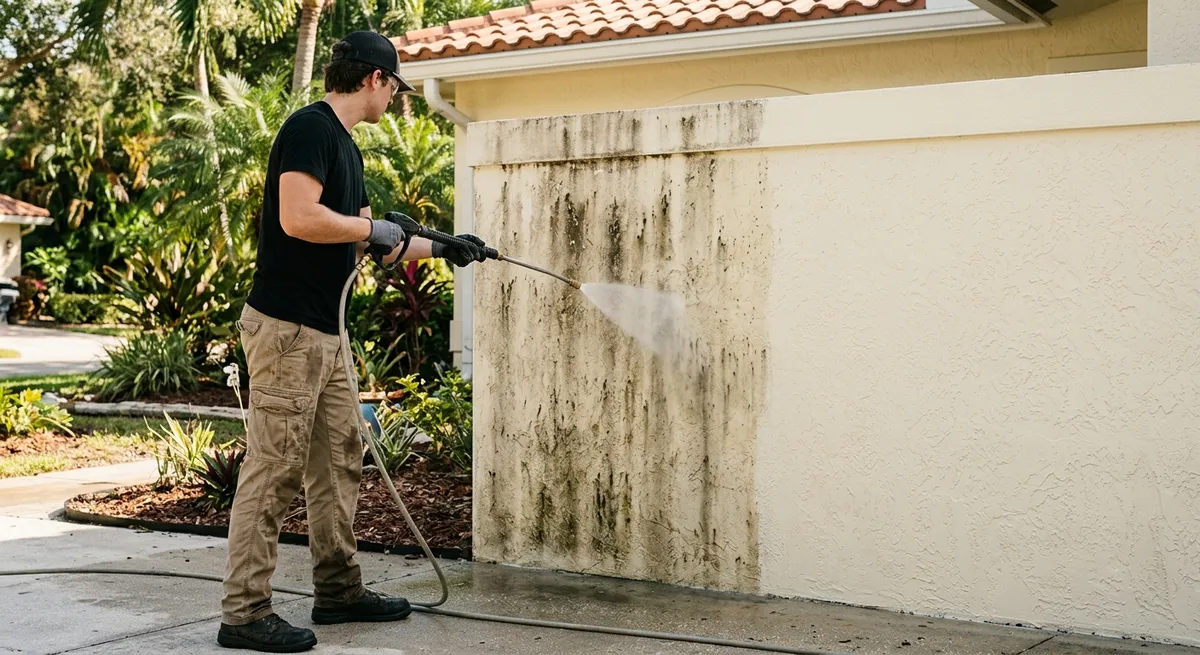
- Stucco walls — pollen embeds in the texture and needs to be dissolved, not just pushed around
- Pavers — pollen settles into joints and pores where water alone won't reach effectively
Soft Washing for Sensitive Surfaces
Your roof, painted surfaces, and screen enclosures need soft washing — lower pressure combined with appropriate cleaning solutions. High pressure would damage these surfaces, but the pollen still needs to come off. Soft washing handles this perfectly.
The Full Property Approach
Pollen doesn't discriminate — it coats everything. The most effective approach is cleaning the full property at once rather than doing surfaces piecemeal. This prevents cross-contamination (cleaning your driveway but having pollen wash off your roof onto the clean driveway in the next rain) and ensures you get a true fresh start for the season.
What Happens If You Skip Post-Pollen Cleaning?
Let's be honest about this. Some homeowners skip it every year and their homes don't fall apart. But here's the progression we typically see:
Year 1 of skipping: Light algae and mold develop over the summer, mostly cosmetic. Rain washes away some pollen. Things don't look great but no real damage. Year 2: Organic growth from the previous year never fully went away. New pollen layer on top of existing growth. Mold takes hold in shaded areas. Gutters develop the first signs of restriction. Year 3: Visible dark streaks on roof and stucco. Green algae established on driveway and walkways. Gutters significantly restricted. Pavers starting to show organic growth in joints. Year 4+: Homeowners at this point often need more intensive (and more expensive) cleaning to undo years of accumulated buildup. Some damage — stained concrete, deteriorated sealant, corroded gutter sections — may be permanent.The compounding effect is real. Each year's pollen layer feeds the growth that makes next year worse. Keeping up with annual post-pollen cleaning prevents this cycle.
Your Post-Pollen Game Plan
Here's what we recommend for homeowners in Palm Beach Gardens, Jupiter, West Palm Beach, and surrounding areas:
1. Schedule your cleaning for late April through mid-May — this is the optimal window 2. Include gutters in your cleaning service — pollen paste doesn't clean itself 3. Consider a full-property wash rather than just the driveway — pollen affects every exterior surface 4. If you have heavy oak or pine coverage, consider a mid-season rinse in March and a full cleaning in May 5. Pair with paver sealing if your sealant is due — clean surfaces seal better, and sealed surfaces resist pollen buildup the following year
Clean Surfaces, Clean Start
Pollen season in South Florida is unavoidable. But the damage it does to your home's exterior is entirely preventable. A well-timed professional cleaning after pollen season removes the buildup, eliminates the conditions that feed summer mold and algae, and gives your home the best possible start to the rainy season.
At Crouching Tiger Exterior Cleaning, we ramp up our schedule during the post-pollen window because demand is high — and for good reason. Homeowners who clean after pollen season consistently have cleaner, better-maintained homes year-round.
Get your free quote today and let us get the pollen off your home before it does more than make things look dusty. We serve Palm Beach Gardens, Jupiter, West Palm Beach, and all of Palm Beach County.