The Invisible Wrecking Ball
Everyone who lives in South Florida knows about humidity. You feel it the second you walk outside. Your glasses fog up when you step out of an air-conditioned car. Your clothes stick to you by noon. It's just part of life in Palm Beach Gardens, Jupiter, West Palm Beach, and everywhere else in our corner of the state.
But most homeowners think of humidity as a comfort issue -- something that makes you sweat, runs up your AC bill, and frizzes your hair. What they don't realize is that humidity is the single biggest threat to your home's exterior, and it's doing damage 24 hours a day, 365 days a year.
The damage isn't dramatic. Your house isn't going to fall down overnight. But humidity is relentless, and its effects compound over time. The stucco discoloration you're ignoring today becomes the structural problem you're paying thousands to fix in a few years. Let's talk about exactly what's happening and what you can do about it.
The Numbers: Just How Humid Is It?
Palm Beach County's average relative humidity runs between 70% and 90% for most of the year. During summer months, morning humidity regularly exceeds 90%, and even afternoon readings (when it's typically lowest) hover around 60-70%.
For comparison, Phoenix averages around 20-30% humidity. Even a "humid" Midwest summer rarely sustains above 70% for extended periods.
Why does this matter for your home? Because most building materials were designed and tested for much drier conditions. The paint on your walls, the sealant on your concrete, the finish on your metal fixtures -- all of these products perform well at 40-60% humidity. Above 70%, the rules change, and above 80%, damage accelerates exponentially.
How Humidity Attacks Every Surface
Stucco: South Florida's Most Common Exterior
The vast majority of homes in Palm Beach County have stucco exterior walls. Stucco is essentially a cement-based plaster applied over concrete block or frame construction. It's durable, affordable, and handles hurricane winds well -- which is why it's everywhere down here.
But stucco has a critical vulnerability: it's porous. Under magnification, stucco is full of tiny pores and micro-cracks that absorb and release moisture. In a dry climate, this isn't a big deal -- moisture enters during rain and evaporates quickly.
In South Florida, the air is already saturated with moisture. Stucco absorbs humidity from the air itself, not just from rain. And because the air is so humid, evaporation happens slowly or not at all. The result:
- Persistent dampness inside the stucco layer creates a perfect environment for mold and algae growth
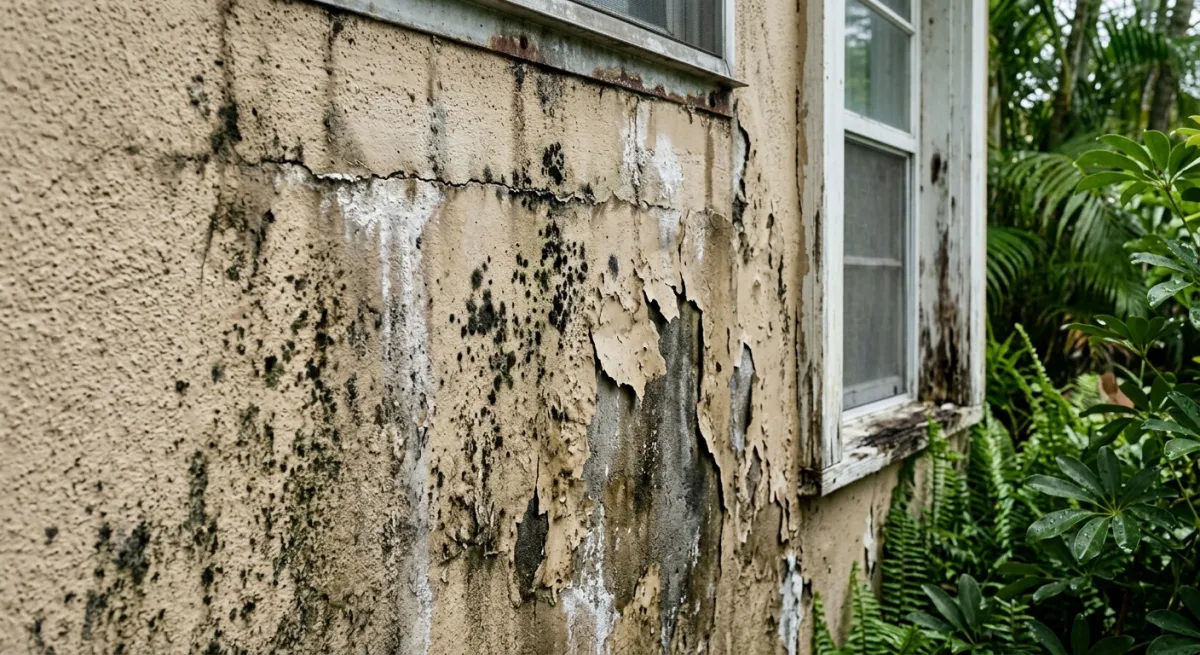
- Mold roots penetrate into the stucco, not just on the surface -- which is why scrubbing off visible mold doesn't solve the problem
- Trapped moisture expands and contracts with temperature changes, creating micro-cracks that allow even more moisture in
- The stucco-to-paint bond weakens as moisture sits between the layers, leading to bubbling, peeling, and paint failure
Concrete and Masonry: The Efflorescence Problem
If you have a concrete driveway, block wall, or masonry features on your property, you may have noticed a white, powdery residue appearing on the surface. That's efflorescence -- and it's a direct consequence of humidity and moisture interaction.
Here's what happens:
1. Moisture (from humidity, rain, or ground water) penetrates the concrete or masonry 2. As it moves through the material, it dissolves soluble salts present in the cement 3. When the moisture reaches the surface and evaporates, it deposits those salts as a white crystalline residue
In a dry climate, efflorescence is a minor cosmetic issue that eventually stops as the salts are depleted. In South Florida, the cycle never stops because moisture is constantly being absorbed. Over time:
- The repeated salt crystallization creates pressure inside the concrete pores, causing surface spalling (flaking and chipping)
- The structural integrity of the concrete is slowly compromised
- The appearance deteriorates progressively, and the surface becomes rougher, which traps more moisture, which accelerates the cycle
Paint: Why It Peels and Bubbles
Florida homeowners repaint their home exteriors far more frequently than homeowners in other states, and humidity is the primary reason. Here's the mechanism:
Paint adhesion depends on a dry substrate. When you paint a surface, the paint bonds to the material underneath as it cures. But when moisture is trapped between the paint film and the substrate (whether that's stucco, wood, or metal), several things happen:- Osmotic blistering -- Moisture migrates through the semi-permeable paint film due to osmotic pressure, creating bubbles under the paint surface
- Adhesion failure -- The bond between paint and substrate weakens as the moisture layer acts as a release agent
- Mildew growth under the paint -- Mold can actually grow between the paint and the wall, feeding on the moisture and organic compounds in the paint itself. You'll see this as dark spots or patches that can't be cleaned because they're under the paint layer.
Wood: Accelerated Rot
Wood components on South Florida homes -- fascia boards, soffits, trim, pergolas, fences, dock pilings -- face an uphill battle against humidity. The process is straightforward but devastating:
1. Wood absorbs moisture from humid air (wood is hygroscopic, meaning it naturally seeks equilibrium with ambient humidity) 2. Sustained moisture content above 20% creates conditions for wood-decaying fungi to thrive 3. Fungi break down the cellulose and lignin in wood -- the structural components that give it strength 4. Softened, weakened wood absorbs even more moisture, accelerating the cycle
In Palm Beach County, unprotected exterior wood can begin showing decay within 2-3 years of installation. Compare that to 10-15 years in a dry climate.
The damage often starts in hidden areas -- the back side of fascia boards, the bottom of fence posts, the joints where pergola beams meet posts. By the time you see visible rot, the damage is usually extensive.
Metal: Corrosion Beyond Just Rust
Metal surfaces on your home -- aluminum soffit and fascia, iron railings, steel hardware, copper fixtures -- all face accelerated corrosion in our climate. And if you're within a few miles of the coast in Jupiter, Palm Beach, or along the Intracoastal, salt air compounds the problem exponentially.
- Iron and steel develop rust as moisture provides the electrolyte for the electrochemical reaction between iron and oxygen. Higher humidity means faster rust, period.
- Aluminum doesn't rust, but it does oxidize. That white, chalky residue on aluminum surfaces? That's aluminum oxide -- and in high humidity, it forms faster and more aggressively.
- Copper develops its characteristic green patina (verdigris) much faster in humid, salt-laden air
- Galvanized steel (like gutter systems) loses its zinc coating faster in high-humidity environments, eventually exposing the steel underneath to rust
The Compound Effect: Why Damage Accelerates
Here's the part that catches most homeowners off guard: humidity damage doesn't progress at a steady rate. It accelerates.
Think of it this way:
- Year 1: Clean surfaces resist moisture well. Sealants and paint are fresh. Damage is minimal.
- Year 2: Micro-cracks develop. Paint begins to thin. Mold establishes small colonies. Each of these creates new pathways for moisture.
- Year 3: Cracks widen. Mold colonies expand. More surface area is compromised. Paint starts bubbling in spots.
- Year 4: Now those small problems are feeding each other. Mold holds moisture against surfaces. Cracks channel water deeper into materials. Paint failure exposes more substrate. Damage is happening significantly faster than in Year 1.
- Year 5+: Full-blown deterioration. What started as a cosmetic issue now involves structural concerns. Repairs that would have cost hundreds now cost thousands.
Mold You Can't See
One of the most concerning aspects of humidity damage is what's happening where you can't see it. Surface mold is obvious -- those black streaks and green patches on your stucco or concrete. But mold is also growing behind your exterior surfaces:
- Inside stucco layers -- between the scratch coat and finish coat, or between the stucco and the underlying block
- Behind exterior trim -- particularly where trim meets wall surfaces
- Inside soffit channels -- the enclosed space between the soffit panel and the roof structure
- In wall cavities -- where moisture that penetrated the exterior meets the cooler, air-conditioned interior, creating condensation
The Prevention Strategy
Alright, enough about the problem. Here's what you can actually do about it. Protecting your home from humidity damage comes down to three pillars: clean, seal, and inspect.
Pillar 1: Regular Cleaning
Cleaning isn't just about appearance -- it's about removing the biological organisms that trap moisture against surfaces and accelerate deterioration.
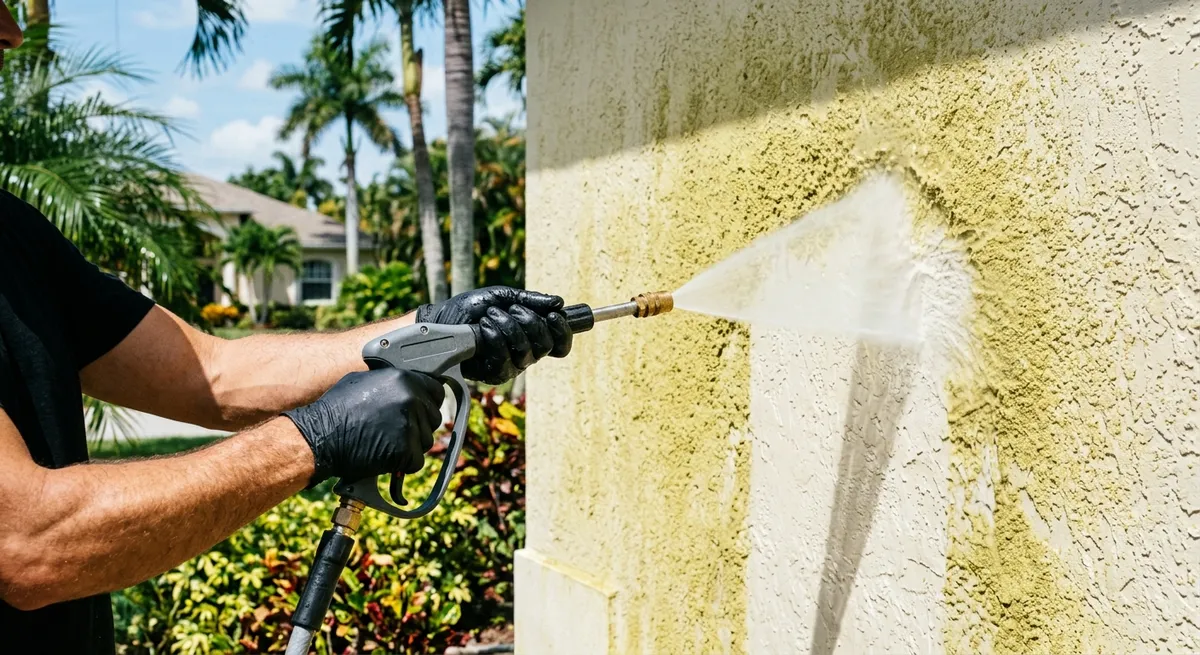
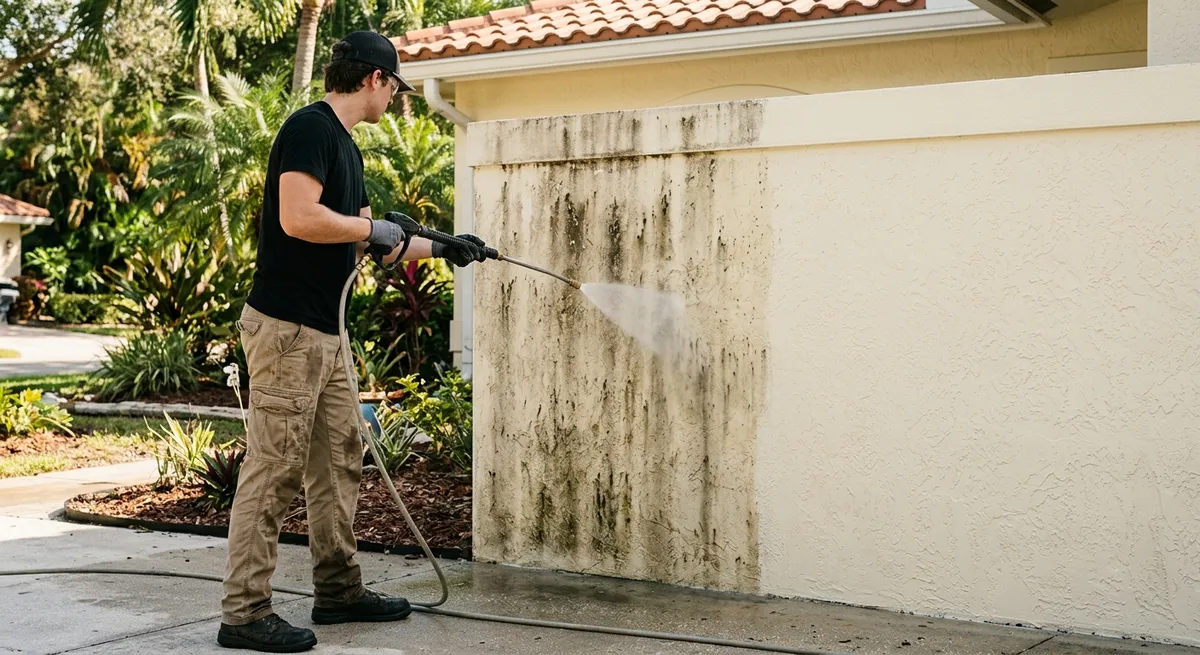
- Soft wash exterior walls every 12-18 months. This kills mold and algae at the root, not just on the surface.
- Pressure wash concrete and paver surfaces every 6-12 months. Organic growth on horizontal surfaces holds moisture like a sponge.
- Clean roof surfaces every 2-3 years. Algae on your roof isn't just ugly -- it's retaining moisture and feeding on your roofing materials.
- Clean gutters at least twice a year. Clogged gutters overflow and dump water against fascia and walls.
Pillar 2: Sealing and Protection
Clean surfaces need protection to resist moisture between cleanings.
- Seal concrete and pavers every 2-3 years with a quality penetrating sealer
- Repaint when paint shows early signs of failure -- don't wait for wholesale peeling. Use paint rated for high-humidity environments and consider elastomeric coatings for stucco.
- Seal wood surfaces with marine-grade sealant or stain. Reapply annually for maximum protection.
- Apply protective coatings to metal -- clear-coat for decorative metals, anti-corrosion treatment for functional hardware
- Reseal grout in exterior tile installations every 12-18 months
Pillar 3: Regular Inspection
Catching problems early prevents the compound effect from taking hold.
- Walk your property quarterly and look at every exterior surface. Note changes in color, texture, or condition.
- Pay special attention to north-facing surfaces -- they get the least sun and stay dampest
- Check areas where different materials meet -- these joints are moisture entry points
- Look for efflorescence on concrete and masonry -- it's an early warning sign of moisture cycling
- Monitor paint condition -- bubbling, cracking, or discoloration are all moisture indicators
- Inspect wood elements by pressing firmly with a screwdriver tip. If it sinks in easily, rot has begun.
Why Waiting Costs More
We talk to homeowners every week who say some version of "I'll get to it next year." And we understand -- home maintenance competes with everything else in life for your time and budget. But the math strongly favors proactive maintenance:
That's not an exaggeration. A single stucco remediation project (repairing moisture damage and mold behind stucco walls) can cost $10,000-$25,000. Repainting a home because the previous paint failed prematurely from moisture runs $5,000-$12,000. Replacing rotted fascia, soffits, and trim adds another $3,000-$8,000.
Regular cleaning and sealing is the insurance policy that actually pays off.
Take Action Before the Damage Compounds
If you're reading this and realizing your home's exterior is overdue for attention, don't panic -- but don't wait, either. Every month you delay allows the compound effect to progress further. The best time to start was a year ago. The second-best time is now.
Start with a professional assessment. We'll walk your property, identify the areas of greatest concern, and recommend a cleaning and maintenance plan tailored to your specific home and budget. From soft washing your walls and roof to pressure washing your driveway and pool deck, we'll help you reset the clock and protect your home against South Florida's most persistent enemy.
Get your free quote today and stop letting humidity quietly destroy your home's exterior.