The Forgotten Surface
Your driveway gets cleaned. Your pool deck gets cleaned. Your lanai gets attention. But your garage floor? Most homeowners in Palm Beach Gardens, Jupiter, and West Palm Beach treat their garage floor like it's invisible -- until they're trying to sell the house, or they've finally had enough of stepping over oil spots every time they get out of the car.
Here's the thing: garage floors in Florida get dirtier, faster, and in worse ways than almost anywhere else in the country. And the longer you wait to address it, the harder (and more expensive) it becomes to fix.
Why Florida Garage Floors Are Especially Bad
You might think a garage floor is a garage floor. But several factors unique to our climate make the problem significantly worse:
Open Garages and Humidity
Most homes in Palm Beach County have two or three-car garages with large doors that are open frequently -- sometimes for hours at a time. Unlike homes in colder climates where the garage stays buttoned up most of the year, our garages are constantly exposed to outdoor humidity. That 80-90% relative humidity accelerates mold growth on any organic material, including oil residue.
Heat Accelerates Oil Penetration
When your car pulls into a hot garage after sitting in a Florida parking lot, the engine and undercarriage are radiating serious heat. Oil drips hit concrete that's already warm from ambient temperature, and warm oil penetrates porous concrete much faster than cool oil. A drip that might sit on the surface in Michigan will sink a quarter-inch into your garage floor in Palm Beach.
Tracked-In Debris
Between yard work, beach trips, trips to the garden center, and just living in a subtropical environment, Florida homeowners track in an extraordinary amount of organic debris. Grass clippings, sand, mulch, fertilizer, pollen -- it all ends up on the garage floor, mixing with oil drips and moisture to create a grimy layer that bonds to the concrete.
No Freeze-Thaw Cycle to Help
In northern states, the freeze-thaw cycle actually helps break up some surface contamination on concrete. Florida doesn't get that free assist. Stains just keep accumulating and compounding year after year.
Types of Garage Floor Stains
Not all stains are created equal, and identifying what you're dealing with determines the right removal approach.
Oil and Transmission Fluid
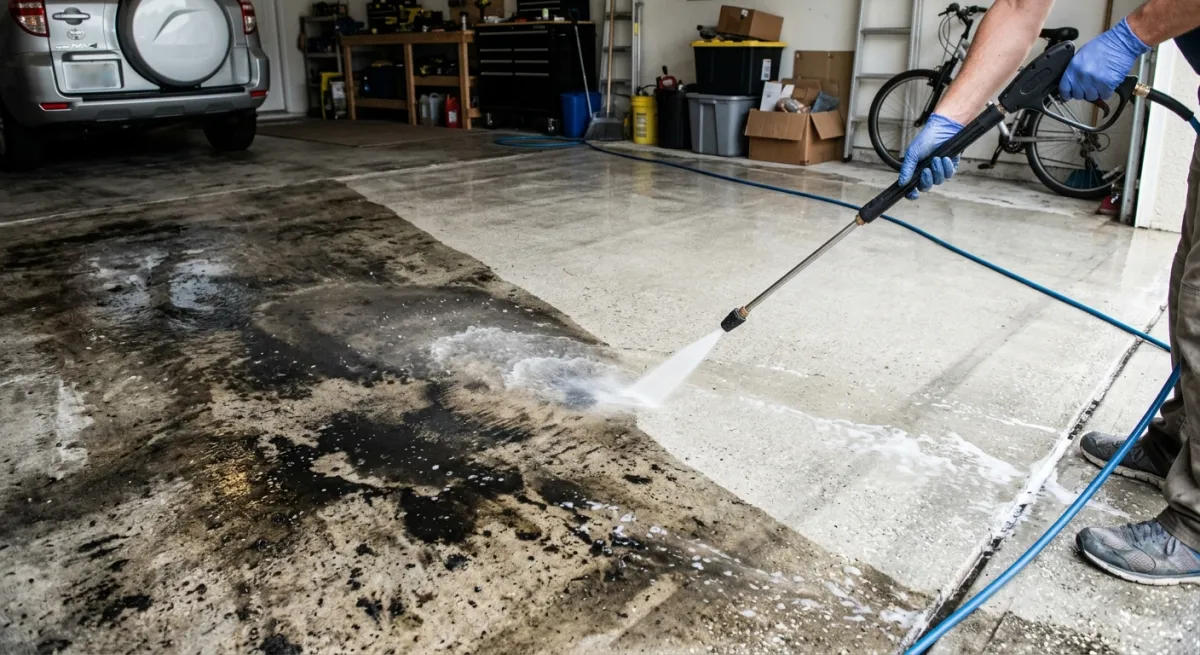
The most common garage floor stain. Fresh oil appears as dark spots; old oil turns into blackened areas that have penetrated deep into the concrete. Transmission fluid is typically reddish-brown and is often mistaken for rust.
Difficulty level: Moderate for fresh stains, difficult to impossible for stains that have been there for years.Rust Stains
Orange or reddish-brown stains, usually caused by:
- Metal objects sitting on damp concrete (tools, paint cans, nails)
- Irrigation water with high iron content
- Vehicles with undercarriage rust dripping onto the floor
Tire Marks
Those dark marks where your tires sit aren't just surface dirt -- they're caused by plasticizers in the tire rubber leaching onto the concrete. Hot tires on hot concrete in a Florida summer create particularly stubborn tire marks.
Difficulty level: Moderate. Requires specific degreasing agents and mechanical agitation.Paint Drips and Spills
Common in garages used for DIY projects. Latex paint is relatively easy to remove if caught early; oil-based paint is much more stubborn.
Difficulty level: Easy (fresh latex) to very difficult (old oil-based paint).Fertilizer and Chemical Stains
Bags of lawn fertilizer stored in the garage often leak, creating rust-colored stains from iron content. Pool chemicals can bleach or etch the concrete surface.
Difficulty level: Varies. Fertilizer stains respond to acid washing; chemical etching may be permanent.Why Hot Water Pressure Washing Works Better for Oil
Standard cold water pressure washing can remove surface dirt and some light staining, but for oil-based stains, hot water makes a dramatic difference. Here's the science:
- Heat breaks the molecular bond between oil and concrete. Oil is a hydrocarbon that becomes less viscous (thinner) as temperature increases, making it easier to extract from concrete pores.
- Hot water emulsifies grease more effectively when combined with degreasers, allowing it to be flushed from the surface rather than just pushed around.
- Surface tension decreases with temperature, allowing hot water to penetrate deeper into the concrete where oil has settled.
The Professional Garage Floor Cleaning Process
Here's what a thorough garage floor cleaning looks like:
Step 1: Assessment and Preparation
We start by identifying every stain type and its approximate age. This determines which pre-treatments to use. We also move any stored items away from the cleaning area and protect walls, shelving, and anything else that shouldn't get wet.
Step 2: Degreaser Pre-Treatment
Before any water touches the floor, we apply a professional-grade alkaline degreaser to oil-stained areas. This is not the stuff you buy at the hardware store -- commercial degreasers are formulated to penetrate concrete and break the bond between oil and the cite matrix.
The degreaser needs dwell time -- typically 10-15 minutes for moderate stains, up to 30 minutes for heavy buildup. During this time, we agitate the surface with stiff-bristle brushes to work the degreaser into the concrete pores.
Step 3: Spot Treatment for Specific Stains
- Rust stains get treated with an oxalic acid solution
- Tire marks get an additional application of solvent-based cleaner
- Paint drips may require mechanical scraping before chemical treatment
Step 4: Hot Water Pressure Washing
This is where the magic happens. We use a surface cleaner attachment -- a spinning disc that provides even, consistent cleaning across the entire floor without the striping that a wand tip creates. Hot water at high pressure flushes out the dissolved oil and grime.
We work in systematic passes to ensure every square inch gets equal treatment. The dirty water is pushed toward the garage door opening for collection.
Step 5: Second Pass and Rinse
Heavily stained areas may need a second round of degreaser and hot water treatment. We make a final rinse pass across the entire floor to remove all chemical residue.
Step 6: Drying and Inspection
We allow the floor to dry and then inspect under good lighting. Some stains, particularly very old oil penetration, may still show as shadows in the concrete. We'll be upfront about what can and can't be fully removed.
How Deep Do Stains Penetrate?
This is the question that determines whether a stain can be fully removed:
- Fresh oil spills (hours to days): Penetration of 1/16 to 1/8 inch. Almost always fully removable.
- Recent stains (weeks to a few months): Penetration of 1/8 to 1/4 inch. Usually removable with professional equipment, though faint shadows may remain.
- Old stains (6 months to a few years): Penetration of 1/4 to 1/2 inch or more. Significant improvement is possible, but complete removal is unlikely. We can typically achieve 70-80% improvement.
- Ancient stains (many years): Penetration can be an inch or more in porous concrete. These stains are part of the concrete at this point. We can lighten them considerably, but they won't disappear entirely.
Sealing Your Garage Floor After Cleaning
Once your garage floor is clean, sealing it is the smartest thing you can do. A quality concrete sealer:
- Prevents future stain penetration -- oil and other fluids bead up on the surface instead of soaking in
- Makes routine cleaning dramatically easier -- sealed concrete can be mopped clean
- Protects against moisture intrusion from Florida's humidity
- Reduces concrete dusting (that fine powder that concrete generates)
- Improves appearance -- sealers come in matte, satin, and gloss finishes
Types of Garage Floor Sealers
Penetrating sealers soak into the concrete and protect from within. They don't change the appearance of the floor and are best for homeowners who want invisible protection. Acrylic sealers sit on the surface and provide a visible sheen. They're affordable and easy to apply but need reapplication every 1-2 years. Epoxy coatings are the premium option -- extremely durable, chemical resistant, and available in a wide range of colors and finishes (including those flake systems you've seen in magazine photos). Professional epoxy application runs $3-$6 per square foot but lasts 5-10+ years. Polyurea/polyaspartic coatings are newer alternatives to epoxy that cure faster and handle Florida's humidity better during application. They're becoming our top recommendation for garage floors in Palm Beach County.Important Note on Timing
Any sealer or coating requires clean, dry concrete for proper adhesion. This is actually one of the best reasons to have your garage floor professionally cleaned -- it prepares the surface for sealing. We recommend waiting 48-72 hours after cleaning before applying any sealer or coating to ensure the concrete is fully dry.
What About DIY Garage Floor Cleaning?
You can certainly tackle light dirt and surface grime with a rented pressure washer and some store-bought degreaser. But here's where DIY typically falls short:
- Consumer pressure washers lack hot water capability -- and as we discussed, hot water is what makes the difference on oil stains
- Store-bought degreasers are significantly weaker than commercial formulations
- Without a surface cleaner attachment, you'll spend hours with a wand tip and still end up with uneven results
- Water management in a garage is tricky -- without proper technique, you'll flood the garage and push dirty water into places you don't want it
Time to Clean That Garage Floor
Whether you're dealing with years of oil stains, prepping for an epoxy coating, or just tired of a grimy floor dragging down your home's appearance, professional garage floor cleaning delivers results that DIY methods simply can't match. The hot water makes the difference, and the commercial equipment does what a rental unit won't.
Ready to see the concrete under all that grime? Get a free quote for professional garage floor cleaning and oil stain removal for your Palm Beach County home.