Why Flat Roofs Are Everywhere in South Florida
Drive through any commercial district in Palm Beach Gardens, Jupiter, or West Palm Beach, and you'll notice something: flat roofs are the norm. Strip malls, office buildings, restaurants, medical offices -- nearly every commercial building in Palm Beach County sits under a flat or low-slope roof.
But it's not just commercial properties anymore. Flat roofs have become increasingly popular on modern residential construction throughout South Florida. Mid-century modern revivals, contemporary new builds, and even additions to existing homes are going flat. There's good reason for it -- flat roofs work well in our climate when maintained properly, they're cost-effective, and they give buildings that clean, modern look that's become so popular in our area.
The problem? Flat roofs require a completely different maintenance approach than traditional sloped roofs. And in South Florida's brutal environment, neglecting that maintenance leads to expensive problems fast.
The Unique Challenges of Flat Roofs in Our Climate
A pitched roof has one major advantage that flat roofs don't: gravity. Water runs off a sloped roof naturally. On a flat roof, water has to find its way to drains, scuppers, or roof edges -- and it doesn't always cooperate.
Standing Water Is the Number One Enemy
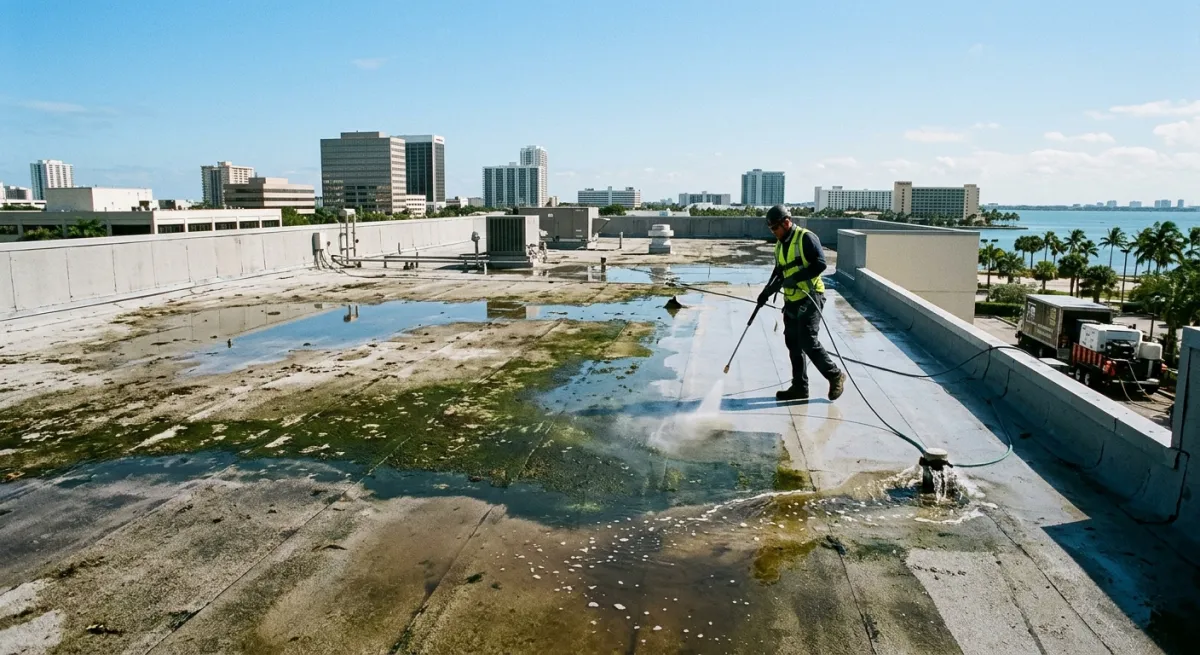
After one of our typical afternoon thunderstorms, a flat roof can hold hundreds of gallons of water in low spots. This pooling water -- sometimes called "ponding" -- creates a cascading series of problems:
- Accelerated algae and mold growth. Standing water in 90-degree heat is basically a petri dish. Algae colonies can establish themselves in days, not weeks.
- Membrane degradation. UV rays reflecting off standing water create a magnifying effect that breaks down roofing membranes faster than dry exposure alone.
- Added structural weight. Water is heavy -- about 5 pounds per square foot per inch of depth. Persistent ponding stresses the roof structure over time.
- Mosquito breeding. This is Florida. Any standing water becomes a mosquito nursery within 48 hours. Your building's roof shouldn't be contributing to the problem.
Debris Accumulation You Can't See from the Ground
With a pitched roof, leaves and debris slide off or get washed away by rain. Flat roofs act like a giant collection tray. Leaves, palm fronds, seed pods, dirt, and even trash blown by wind all accumulate up there. Since you can't see it from ground level, most property owners have no idea how much debris is sitting on their roof.
That debris does real damage. It traps moisture against the roof membrane, clogs drains and scuppers, creates dam effects that worsen ponding, and provides organic material for mold and algae to feed on.
Hidden Damage Goes Unnoticed
On a sloped roof, problems are often visible from the ground -- missing shingles, sagging areas, obvious staining. Flat roofs hide their problems. Membrane tears, blistering, seam separation, and flashing failures can all develop out of sight. By the time you notice a leak inside the building, the damage has often been progressing for months.
Why Flat Roofs Grow Mold and Algae Faster
We mentioned this above, but it's worth expanding on because this is the core reason flat roofs need regular cleaning in South Florida.
Pooling water plus heat plus organic debris equals explosive biological growth.On a sloped tile or shingle roof, algae grows gradually because water runs off and surfaces dry relatively quickly between rains. A flat roof stays wet for hours or even days after rain, especially in low spots and areas blocked by debris or HVAC equipment. The roof surface may never fully dry during our rainy season from May through October.
This constant moisture creates an environment where:
1. Black algae (Gloeocapsa Magma) colonizes the membrane surface, creating dark staining that absorbs more heat 2. Green algae and moss establish in debris pockets and around penetrations 3. Mold colonies develop on the underside of ponding areas 4. Lichen takes hold on older membranes, particularly around roof edges and equipment bases
The biological growth itself holds more moisture, which promotes more growth. It's a self-reinforcing cycle that only gets worse without intervention.
How to Properly Clean a Flat Roof
Here's where flat roof cleaning diverges sharply from how we'd clean a pitched residential roof. The approach needs to be gentler and more strategic.
Low-Pressure Washing Only
A flat roof membrane -- whether it's TPO, EPDM, modified bitumen, or built-up roofing -- is designed to be waterproof, not pressure-proof. High-pressure washing can:
- Tear or puncture the membrane
- Break seam bonds and cause delamination
- Force water under the membrane through small imperfections
- Damage flashing around penetrations and edges
Chemical Selection Matters
The cleaning solutions used on a flat roof must be compatible with the roofing material. Harsh chemicals can:
- Degrade TPO and PVC membranes
- Dry out and crack EPDM rubber
- Dissolve the asphalt in modified bitumen roofing
- Damage flashing sealants
The Cleaning Process Step by Step
Here's how a professional flat roof cleaning typically goes:
1. Initial inspection. Before any water hits the roof, we walk the entire surface checking for damage, ponding areas, debris accumulation, and drain conditions. We document anything that needs attention. 2. Debris removal. All loose debris -- leaves, branches, dirt accumulation -- gets removed by hand first. This is critical because washing debris into drains is a guaranteed way to create clogs. 3. Drain and scupper clearing. Every drain, scupper, and overflow is inspected and cleared. If drains are partially blocked, we clear them before adding any water to the roof. 4. Pre-treatment. Our cleaning solution is applied across the roof surface, with extra attention to heavily stained or growth-covered areas. This sits for 15-20 minutes to break down biological growth. 5. Low-pressure rinse. We work in sections, rinsing toward functioning drains to ensure water flows off the roof properly. We never push water toward edges or areas without proper drainage. 6. Post-cleaning inspection. After cleaning, we inspect again. A clean roof reveals problems that were hidden under grime -- membrane damage, failing seams, deteriorating flashing. We document and report anything we find.
Inspecting Drains and Scuppers During Cleaning
This is one of the most valuable parts of professional flat roof cleaning, and it's something most property owners never think about.
Drains and scuppers are your flat roof's entire drainage system. If they fail, water has nowhere to go. Blocked drains are the leading cause of flat roof leaks and premature roof failure in South Florida.During every cleaning, we inspect:
- Interior drains for debris buildup, deteriorating strainer baskets, and proper flow
- Scuppers (wall openings) for blockages, damaged conductor heads, and proper sizing
- Overflow drains to ensure they're functional as backup
- Downspout connections where they meet the drain system
- Gutter systems on roof edges for proper slope and flow
How Often Should You Clean a Flat Roof?
The answer depends on several factors, but here are general guidelines for South Florida properties:
The most important thing is consistency. A flat roof that gets cleaned on a regular schedule stays in dramatically better condition than one that gets attention only when problems become visible.
The Connection Between a Clean Roof and Roof Longevity
Here's the business case, especially for commercial building owners:
A typical flat commercial roof in South Florida costs $8-$15 per square foot to replace. For a 10,000 square foot building, that's $80,000 to $150,000. Most flat roof systems are rated for 15-25 years, but that rating assumes proper maintenance.
Regular cleaning directly extends roof life by:- Preventing biological growth from degrading the membrane
- Eliminating moisture traps that accelerate deterioration
- Keeping drainage systems functional so water doesn't pond
- Catching small problems before they become big (and expensive) ones
- Maintaining the reflective properties of light-colored membranes (which reduces cooling costs)
A Note for Commercial Building Owners
If you own or manage commercial property in Palm Beach County, flat roof maintenance should be a line item in your annual budget -- not an afterthought.
Beyond the direct costs of roof damage, consider:
- Tenant disruption from leaks (and potential liability)
- Insurance implications -- many policies require evidence of regular maintenance
- Energy costs -- a dirty, dark-stained roof absorbs significantly more heat than a clean, reflective one
- Code compliance -- some municipalities require documented roof maintenance for commercial properties
Keep Your Flat Roof Clean and Functional
Whether you own a commercial building in West Palm Beach, manage a strip mall in Palm Beach Gardens, or have a modern flat-roof home in Jupiter, regular professional cleaning is the single most impactful thing you can do to protect your roof investment.
We specialize in low-pressure flat roof cleaning throughout Palm Beach County. Our team understands the specific challenges that South Florida's climate throws at flat roofing systems, and we have the equipment and expertise to clean them safely and thoroughly. Get a free quote for your flat roof cleaning and start protecting your investment today.