Every Fence and Wall in Palm Beach County Has the Same Problem
Drive through any neighborhood in Palm Beach Gardens, Jupiter, or West Palm Beach and you'll see it — fences and walls that are green, black, streaked, or just generally grimy. It doesn't matter if the fence is brand new vinyl or the CBS wall has been there for 30 years. In our climate, organic growth doesn't discriminate.
But here's what a lot of homeowners don't realize: the cleaning method that works great on one surface can destroy another. Pressure washing a vinyl fence is fine. Pressure washing a wood fence can blow it apart. Soft washing a CBS wall is ideal. Soft washing an aluminum fence is overkill.
Understanding what you have, how it gets dirty, and what it takes to clean it properly — that's the difference between a fence that looks great and one that needs replacing.
Common Fence and Wall Types in Palm Beach County
Let's break down what you're likely looking at around your property.
Vinyl / PVC Fences
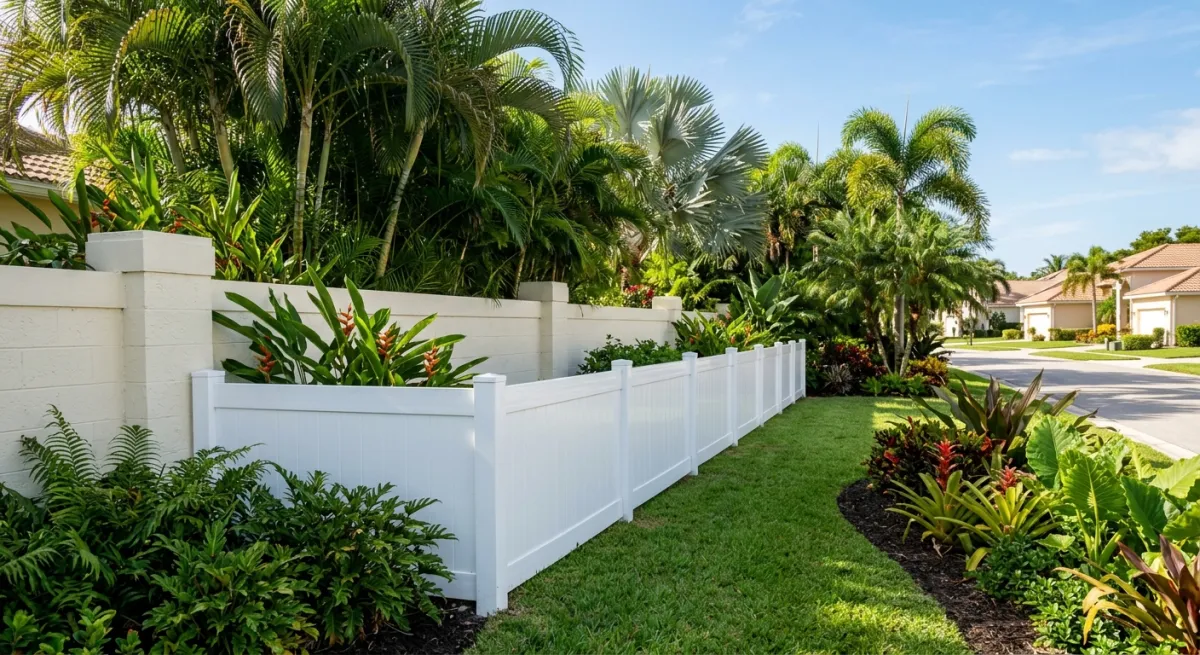
Vinyl fencing is everywhere in Palm Beach County. It's the standard for most newer developments, and HOAs love it because it's uniform and low-maintenance. You'll see it in white, tan, and occasionally gray.
How it degrades: Vinyl doesn't rot, rust, or decay. But it does grow algae — and fast. That green film that coats your white vinyl fence within months of installation? That's algae, not staining. The surface of vinyl is slightly textured at a microscopic level, giving algae the tiny grip it needs to take hold. UV exposure also causes the surface to oxidize over time, which makes it slightly chalky and even more hospitable to organic growth. What you'll see: Green algae coating (most common), black mold spots near the base where moisture sits, and sometimes a general dingy gray appearance from oxidation and accumulated grime. The good news: Vinyl cleans up beautifully. Because the growth is sitting on the surface rather than penetrating it, a proper cleaning brings vinyl fences back to looking nearly brand new.Aluminum Fences
Aluminum is the go-to for pool enclosures and property borders, especially when you want visibility rather than privacy. Common in neighborhoods around PGA Boulevard and throughout Jupiter.
How it degrades: Aluminum doesn't rust, which is why it's so popular in Florida. However, the powder coating on aluminum fences does break down from UV exposure over time. Once the coating starts failing, you'll see oxidation spots and a chalky residue. Organic growth is less of an issue on aluminum than vinyl because the smooth, non-porous surface doesn't give algae much to grab onto. What you'll see: Oxidation and chalking of the powder coat, occasional mildew spots, water stains, and general environmental grime. Near salt air (closer to the coast), you may see some pitting if the coating has failed. Key consideration: Aluminum fences are relatively delicate. The individual pickets can bend under pressure, and harsh chemicals can damage the powder coating. Cleaning needs to be gentle.Wood Fences
Less common than vinyl or aluminum in newer developments, but still found throughout older parts of Palm Beach Gardens, West Palm Beach, and especially in areas with larger lots. Cedar and pressure-treated pine are the most common types.
How it degrades: Wood is organic material in a tropical climate — it's in a constant battle. Moisture penetrates the grain, creating an ideal environment for mold, mildew, and algae. Pressure-treated wood resists rot for a while, but the treatment breaks down over time. Cedar has natural resistance, but even cedar eventually succumbs to Florida's humidity. What you'll see: Green algae and mold growth, gray weathering from UV exposure, black mildew staining, and in advanced cases, soft spots indicating rot. Wood fences near irrigation zones or in shaded areas deteriorate fastest. Critical point: Wood fences are the most commonly damaged by improper cleaning. We see it constantly — homeowners or inexperienced pressure washers blast wood with too much pressure and destroy the grain, create furring (raised fibers), or blow out the softer parts of the wood entirely.CBS / Concrete Block Walls
CBS (Concrete Block and Stucco) walls are a staple of Palm Beach County properties. They serve as property dividers, privacy walls, and often run along major roads and community borders. If you live in a gated community, chances are a CBS wall surrounds your entire neighborhood.
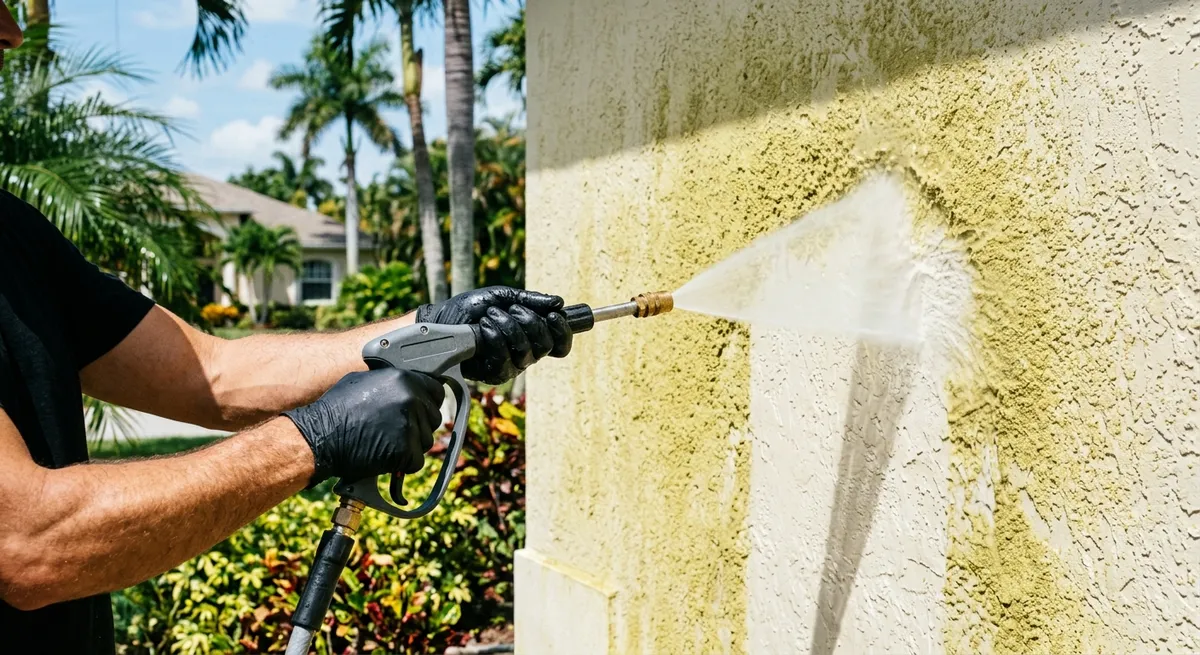
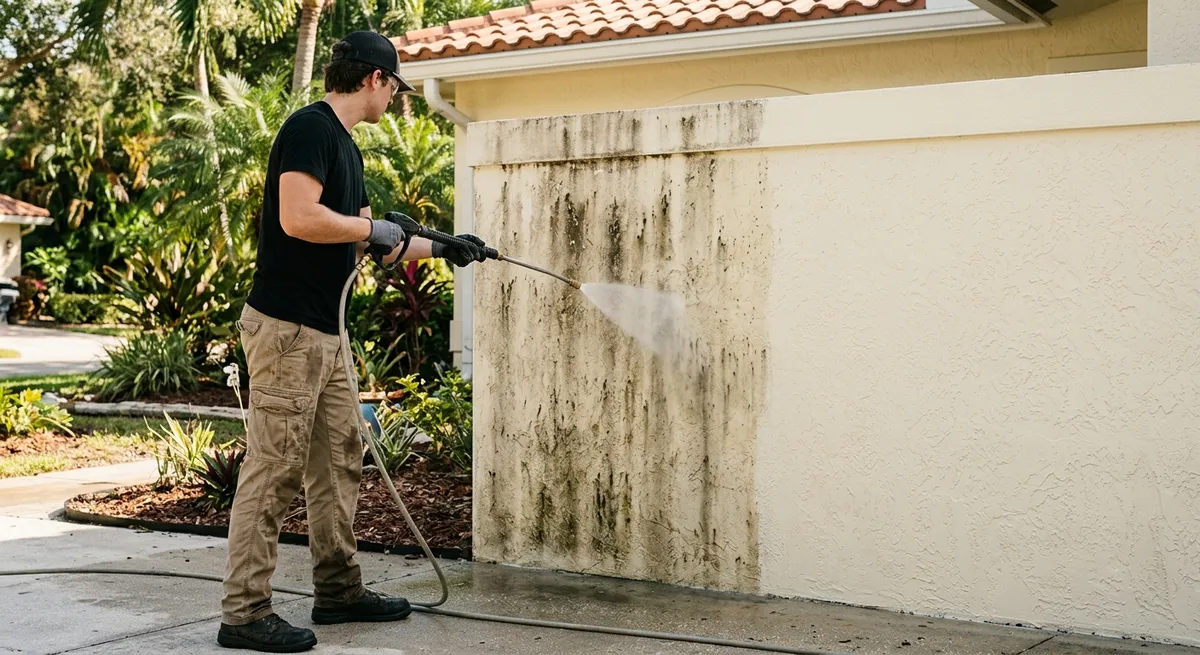
How it degrades: Concrete block is porous. When finished with stucco, the surface provides an ideal substrate for organic growth. Moisture gets trapped in the pores and the rough texture of stucco gives algae, mold, and mildew thousands of tiny places to anchor. The north-facing side of any CBS wall will grow mold significantly faster because it gets less direct sunlight. What you'll see: Heavy black mold and mildew, often in streaking patterns that follow water flow. Green algae, especially at the base and in areas near irrigation. Efflorescence (white mineral deposits) where moisture is migrating through the block. On older walls, the stucco itself may be deteriorating with cracks and spalling. The pattern: CBS walls almost always show the worst growth on the side that faces north or is shaded by trees. One side of the wall may look fine while the other side is completely black. This is normal — it's all about sun exposure and moisture retention.Stucco Walls (On Homes)
Different from CBS perimeter walls, stucco on your actual home's exterior walls collects plenty of growth on its own. The texture of stucco finish — whether smooth, knockdown, or heavy texture — determines how aggressively it attracts organic material.
How it degrades: Similar to CBS walls, but with the added concern that improper cleaning can damage paint and the stucco itself. Heavy-texture stucco is particularly prone to trapping moisture and organic growth in its crevices. What you'll see: Mildew streaks beneath windows and rooflines (where water drips and sits), green algae on lower sections near landscaping, and darkening of the overall surface color over time.Proper Cleaning Methods by Material Type
Here's where the details matter. Each material needs a specific approach.
Vinyl Fences: Low to Medium Pressure + Cleaning Solution
Vinyl is tough enough to handle some pressure, but it doesn't need a lot. We use:
- Pressure: 1,000-1,500 PSI — enough to remove the growth efficiently, gentle enough not to damage the surface or compromise the structural integrity of the fence panels
- Technique: Start from the top and work down. Use a wide fan tip to distribute pressure across the surface. Pay extra attention to the base where moisture accumulates
- Chemistry: A mild bleach-based solution applied before pressure washing kills the algae and makes it release from the surface far more easily. Without this step, you're just mechanically removing the top layer and leaving the roots behind
Aluminum Fences: Low Pressure + Hand Application
Aluminum requires the gentlest approach of any fence type.
- Pressure: Under 1,000 PSI, and even that should be used carefully. We often hand-apply cleaning solution and use a soft brush on aluminum fences
- Technique: Work one section at a time. Avoid directing high pressure at connection points where pickets meet rails — these are the weakest spots
- Chemistry: A gentle cleaning solution that won't strip or damage the powder coating. Avoid anything highly acidic or highly alkaline
Wood Fences: Very Low Pressure + Chemical Treatment
Wood is the surface where the most damage happens from improper cleaning. Here's how we handle it:
- Pressure: Under 800 PSI. Seriously. Wood is soft and the grain structure is easily damaged. We use volume (gallons per minute) rather than pressure to rinse cleaning solutions
- Technique: Apply chemical solution, allow dwell time, and rinse gently. Never hold the nozzle close to the wood surface. Always spray with the grain, not against it
- Chemistry: A sodium percarbonate (oxygen bleach) solution is ideal for wood. It kills organic growth without damaging wood fibers or affecting the color the way chlorine bleach would
CBS Walls and Stucco: Soft Wash Approach
CBS walls and stucco surfaces get our full soft wash treatment.
- Pressure: Low — under 500 PSI for application, gentle rinse to follow
- Technique: Apply cleaning solution from bottom to top (this prevents drip streaks on the dry surface above), allow 10-15 minutes of dwell time, then rinse from top to bottom
- Chemistry: A professional-strength sodium hypochlorite solution that kills mold, mildew, and algae at the root. This is essential for porous surfaces like stucco — mechanical cleaning alone won't reach the growth inside the pores
HOA Requirements for Fence and Wall Appearance
If you live in a managed community in Palm Beach County — and most people do — your HOA almost certainly has maintenance standards for fences and walls. Common requirements include:
- Vinyl fences must remain free of visible mold, mildew, and algae. Many HOAs send violation notices once green growth is visible from the street or common areas.
- Wood fences must be maintained in good repair — no missing boards, no leaning, and no excessive weathering or growth.
- Perimeter walls are often the HOA's responsibility, but individual property walls and fences are typically the homeowner's obligation.
- Some HOAs specify cleaning frequency. We've seen communities in Palm Beach Gardens that require exterior cleaning at least annually, with fines for non-compliance.
How Often Should You Clean Your Fence or Wall?
Here's what we recommend based on years of cleaning in Palm Beach County:
These are general guidelines. Properties near canals, lakes, or the Intracoastal typically need more frequent cleaning. Same for properties with heavy irrigation near fence lines — that constant moisture accelerates growth significantly.
Get Your Fences and Walls Looking New
Whether you've got a vinyl fence that's turned green, a CBS wall that's gone completely black, or a wood fence that's seen better days, we handle it all. We adjust our methods and chemistry to your specific surfaces so you get the best results without any risk of damage.
Get a free quote for fence and wall cleaning — we'll come take a look at what you've got and give you an honest assessment of what it needs and what it'll cost. Serving Palm Beach Gardens, Jupiter, West Palm Beach, and all of Palm Beach County.