Forget Spring and Fall -- We Play by Different Rules
Up north, the answer to "when should I pressure wash my house?" is simple: spring. The snow melts, the mud dries, and everybody cleans up their property. Nice and predictable.
Down here in South Florida? It's a completely different game. We don't have four seasons. We have two: wet and dry. And understanding how these two cycles affect your exterior surfaces is the key to scheduling your cleaning at the right time.
Get the timing right, and your home stays cleaner longer, your surfaces last longer, and you get more value from every cleaning dollar. Get it wrong, and you're paying to clean a house that's going to look dirty again in weeks.
Let's break this down season by season -- the South Florida way.
South Florida's Two Seasons (And What They Do to Your Home)
The Wet Season: May Through October
This is when South Florida earns its reputation. From roughly mid-May through October, we get the daily afternoon thunderstorms, sustained high humidity (often 80-90%), and temperatures that hover in the low to mid 90s.
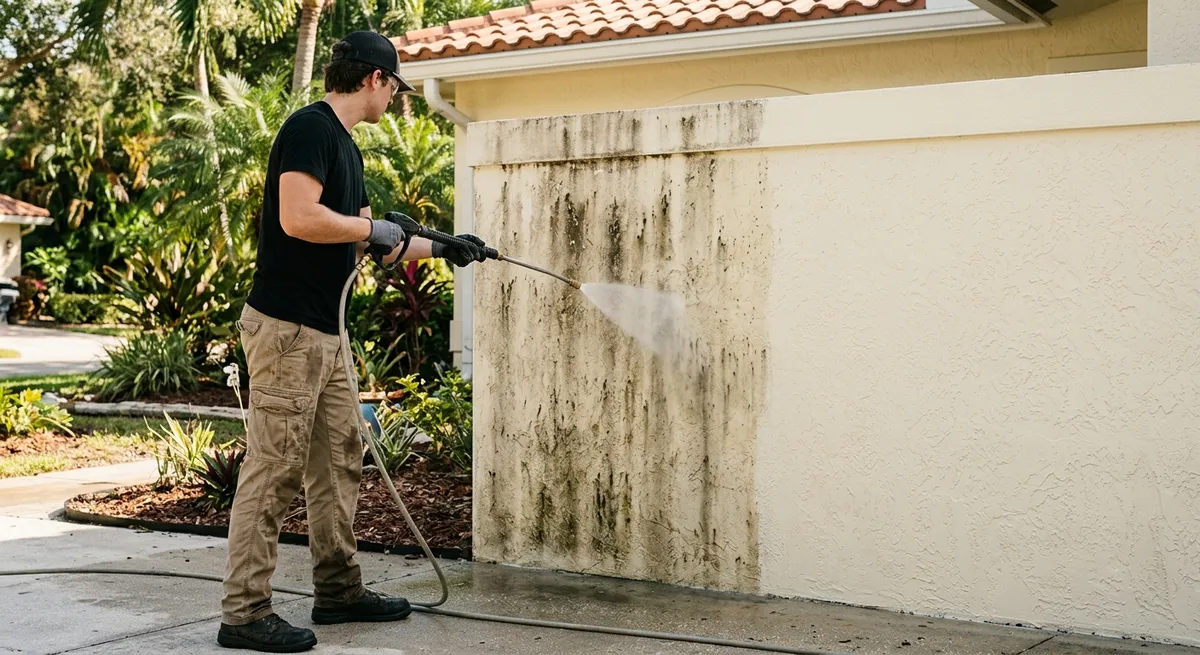
What the wet season does to your exterior:- Mold and algae explode. Constant moisture plus heat creates ideal growing conditions. You can literally watch green and black growth spread on north-facing walls, fences, and shaded surfaces week by week.
- Roof staining accelerates. Gloeocapsa Magma algae thrives in wet conditions and spreads rapidly across roof surfaces.
- Driveways stay perpetually damp. Daily rain means concrete and pavers rarely dry out completely, which promotes biological growth and staining.
- Screens get gross. Pool enclosures and window screens develop green algae film quickly in the humidity.
- Rust stains appear. Irrigation systems running in combination with heavy rain can leave rust deposits, especially near well water sources.
The Dry Season: November Through April
Starting around November, the rain drops off dramatically. Humidity decreases (relatively -- it's still Florida), temperatures cool to the 70s and 80s, and we get those stretches of beautiful, dry weather that make everyone else jealous.
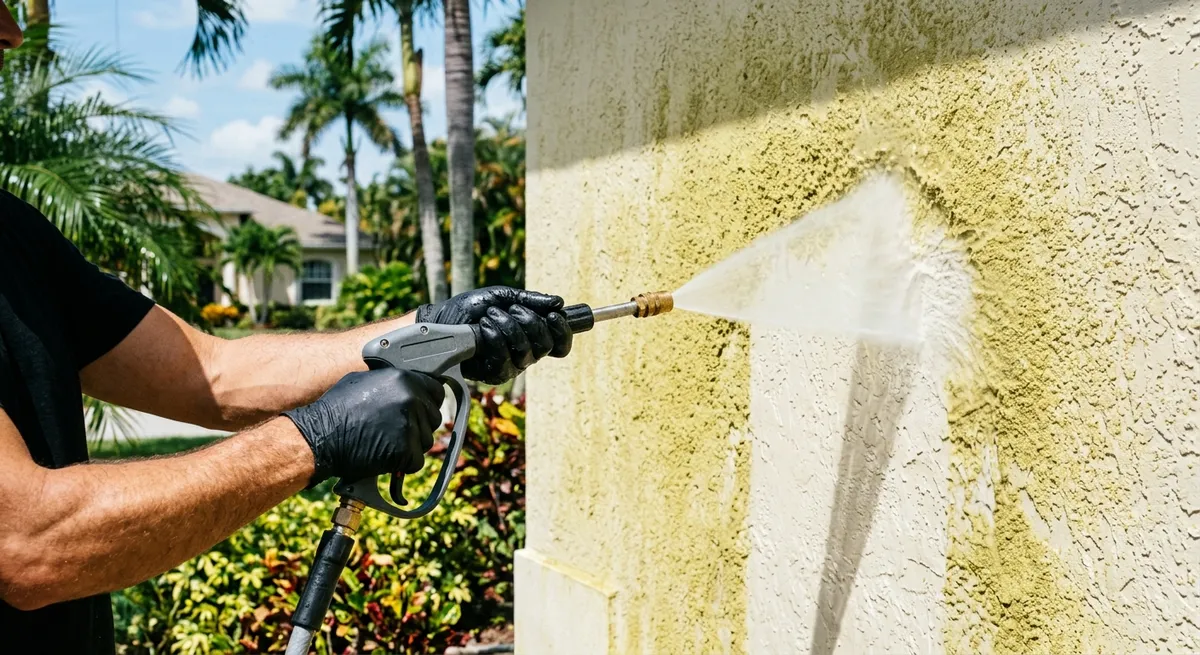
What the dry season does to your exterior:- Dust and pollen accumulate. Without regular rain to wash surfaces, fine dust builds up on everything. Then in February-March, oak pollen season hits and covers every outdoor surface in a yellowish-green film.
- Tannin staining peaks. Live oaks drop leaves primarily in March and April, creating heavy tannin staining on driveways and walkways.
- Surfaces dry out. This is actually good -- dry surfaces are ideal for sealing, and biological growth slows without constant moisture.
- Salt air builds up. Coastal properties in Jupiter and along the Palm Beach Gardens coast accumulate salt deposits that don't get washed off by regular rain.
The Case for Fall Cleaning (October-November)
Many of our clients in Palm Beach County schedule their primary annual cleaning in the fall, and for good reason.
Post-Hurricane Season Reset
Hurricane season runs June through November, with peak activity August through October. Even if a storm doesn't hit directly, the outer bands, tropical moisture, and sustained wind events deposit debris, salt, and organic material across your property.
A thorough cleaning in late October or November essentially resets your home's exterior after the most punishing months of the year. You're removing six months of accumulated mold, algae, debris, and staining all at once.
Snowbird-Ready Curb Appeal
Let's be real -- a lot of homeowners in Palm Beach Gardens, Jupiter, and West Palm Beach head north for the summer and return in the fall. Nothing's less welcoming than coming home to a house that's been growing mold for six months.
We work with a lot of seasonal residents who schedule cleaning for mid-to-late October, right before they return. The house looks perfect for their arrival, and they enjoy clean surfaces through the pleasant winter months.
Ideal Conditions for Sealing
If you're combining cleaning with concrete or paver sealing, fall is the perfect window. The rain has tapered off, humidity is dropping, and sealers cure properly without the risk of an afternoon downpour ruining the application.
Your Home Stays Clean Longer
Surfaces cleaned in the fall benefit from the dry season that follows. Without daily rain feeding biological growth, your clean surfaces stay clean for months. Compare that to cleaning in May, right before the wet season begins -- you might see visible algae returning within weeks.
The Case for Spring Cleaning (March-April)
Spring cleaning has its advocates too, and the logic is sound.
Post-Pollen Season Cleanup
If you've been through a South Florida spring, you know the pollen situation. Live oak catkins, pine pollen, and various flowering tree pollens coat every outdoor surface from February through April. Once the pollen season wraps up, a thorough cleaning removes all that buildup.
Pre-Rainy Season Preparation
Cleaning in April or May, before the wet season begins, gives your surfaces a head start. Mold and algae grow fastest on dirty surfaces because the organic material gives them something to feed on. A clean surface takes longer to get re-colonized, even in the wet season.
Combined with Roof Cleaning
Spring is often an excellent time for roof cleaning. The roof has accumulated growth through the winter (yes, it still grows, just slower), and cleaning before the wet season means your roof stays clean through the most brutal months.
Why Twice a Year Is the Sweet Spot
For most homes in Palm Beach County, the ideal schedule is two cleanings per year: one in the fall (October-November) and one in the spring (March-April).
Here's why twice a year works so well:
Fall cleaning removes the wet season's damage, prepares your home for the social season (holidays, gatherings), and takes advantage of dry conditions for sealing. Spring cleaning removes dry season dust, pollen, and tannin staining, and prepares surfaces for the wet season ahead.This six-month rotation means your surfaces never go more than half a year without attention. That's important because in South Florida, six months is about the maximum before biological growth starts causing actual surface damage, not just cosmetic issues.
The Twice-a-Year Schedule in Practice
The Worst Time to Schedule: July and August
If there's one time we'd steer you away from scheduling, it's the peak of summer -- July and August specifically.
Here's why:
Daily Rain Disruptions
During peak wet season, Palm Beach County gets afternoon thunderstorms almost every single day. Sometimes they start at 2 PM, sometimes at 4 PM. The timing is unpredictable. This means:
- Work gets interrupted or rescheduled frequently
- Freshly cleaned surfaces get rained on before they dry
- Sealing is essentially impossible
- Scheduling becomes unreliable
Extreme Heat
Surface temperatures in direct South Florida sun can exceed 140 degrees F in July and August. This creates problems:
- Cleaning solutions dry too fast, reducing effectiveness
- Workers face heat exhaustion risk, slowing the job
- Concrete and paver surfaces are hot enough to affect chemical reactions
Surfaces Get Dirty Again Immediately
The combination of daily rain and extreme humidity means biological growth returns almost immediately after cleaning. We've seen surfaces start showing algae within two to three weeks of a July cleaning. You're spending money for results that don't last.
The Exception
The one reason to clean during summer is if you have a specific event -- selling your home, hosting an event, HOA compliance deadline. In those cases, we'll absolutely do the work. Just know that the results won't last as long as a fall or spring cleaning.
How to Time Specific Services
Not all exterior cleaning services have the same optimal timing. Here's our service-by-service recommendation:
Roof Soft Washing
Best time: October-November or March-AprilRoof cleaning results last 2-3 years in South Florida, so you don't need to time this as precisely. However, the dry season gives the cleaning solution maximum dwell time and effectiveness. Avoid roof cleaning during peak wet season -- the daily rain dilutes cleaning solutions and washes them off before they've fully worked.
House Washing
Best time: Year-round, with preference for October-NovemberHouse washing is less weather-sensitive than other services because the results are relatively long-lasting. The soft wash solutions kill biological growth at the root, so even if it rains the next day, the treatment continues working. That said, fall timing gets you the freshest-looking results going into the social season.
Driveway and Walkway Pressure Washing
Best time: October-November (cleaning + sealing) or March-April (cleaning only)If you're combining cleaning with sealing, fall is the clear winner because of the dry weather that follows. For cleaning only, either fall or spring works well. Avoid scheduling driveway cleaning right before heavy tree leaf drop -- there's no point cleaning a driveway in early March if your live oaks are about to dump leaves for the next six weeks.
Paver Sealing
Best time: November through FebruaryPaver sealing is the most weather-sensitive service we offer. The sealer needs 48-72 hours without rain to cure properly, and the surface must be completely dry. The dry season -- particularly November through February -- provides the most reliable windows for this work. We will not seal pavers during the wet season unless conditions are exceptional.
Pool Enclosure Cleaning
Best time: Year-round, with extra attention in OctoberScreen enclosures get dirty constantly in South Florida. If you're doing one cleaning per year, October is ideal -- you remove the wet season's algae buildup and enjoy clean screens through the pleasant months when you're actually spending time by the pool.
Fence and Wall Cleaning
Best time: Whenever needed, ideally paired with other servicesFences and perimeter walls don't have optimal timing per se, but they benefit from being cleaned at the same time as your house or driveway. This saves on mobilization costs and gives your entire property a uniform clean appearance.
Planning Your Schedule: A Practical Approach
Here's what we tell homeowners who ask us to put together a maintenance plan:
Budget-conscious (one cleaning per year): Schedule for late October or early November. You get the most impactful cleaning after the wet season, and your home looks great through the holidays and winter social season. Recommended (two cleanings per year): Fall cleaning in October-November with spring follow-up in March-April. Add sealing in the fall visit as needed. Premium (quarterly attention): Fall deep clean, winter touchup, spring deep clean, summer spot treatment. This keeps your home looking immaculate year-round, which some homeowners -- particularly those with HOA requirements or high-end properties -- prefer.Don't Overthink It -- Just Start
The best time to start a regular cleaning schedule is now. Regardless of what month you're reading this, getting your home cleaned today puts you on the path to a maintenance routine that protects your investment.
We work with hundreds of homeowners throughout Palm Beach Gardens, Jupiter, West Palm Beach, and the surrounding communities. We'll help you build a schedule that makes sense for your property, your budget, and your goals. Get a free quote and let's get your home on a cleaning calendar that works.